The short answer
Yes, when a pain keeps coming back, has changed how you play for more than two or three weeks, or you are returning after an injury or starting a new sport. It is usually not worth it for ordinary soreness that fades in a few days. At our North Dallas clinic every visit is 60 minutes, one-on-one with Dr. Brent Lockett, PT, DPT, and the published packages work out to $130 to $140 a visit.
- A sports physical therapist is worth it when a problem keeps coming back, has changed how you move for more than two or three weeks, or you are returning from an injury or starting something new.
- It is usually not worth it for ordinary soreness, for a new ache that is already improving, or when strong in-network benefits cover a simple problem.
- A joint that swells within hours, gives way or locks, or any numbness or weakness, needs a physician first.
- A visit here is 60 minutes, one-on-one with Dr. Lockett: full-body evaluation, hands-on treatment and loading in the same hour, with your training changed rather than stopped.
- Published packages: 6 visits for $840 ($140 a visit) and 12 visits for $1,560 ($130 a visit). The discovery visit is free, and no referral is needed to start.
You play pickleball three mornings a week, run the Katy Trail before work, lift after the kids are in bed, or protect a Saturday tee time like a meeting. Nobody pays you to do it. Then a calf, an elbow or a lower back starts to complain, and you wonder whether a sports physical therapist in Dallas is a sensible spend for someone who is not an athlete for a living.
Here is the straight answer we give at the clinic: when it pays for itself, when it does not, what a visit includes, what it costs here, and how to tell which group you are in.
When a sports physical therapist is worth it, and when it is not
Whether a visit is worth paying for has little to do with how seriously you compete. It depends on the kind of problem you have. A problem that keeps coming back, or one that has started to change how you move, is worth paying for. Ordinary soreness is not.
| Your situation | Worth it? | Why |
|---|---|---|
| The same ache returns every time you build back up | Yes | A problem that recurs in the same place usually means the underlying strength or range was never rebuilt |
| Pain has changed your swing, stride, grip or lift for more than two or three weeks, even after you cut back | Yes | Sensible changes have had their chance; now you need to know which tissue it is and what it can take |
| You are coming back after an injury or months off | Yes | Pain-free is not the same as ready, and starting where you left off is how most people get hurt a second time |
| You are starting a new sport, or have a race or tournament on the calendar | Yes, and early | Most injuries in active adults follow a jump in load; there is time to fix what turns up |
| No pain, no old injury, a steady routine | Optional | A screen finds limits before they hurt, but it cannot predict every injury |
| Whole-muscle soreness a day or two after a hard or unfamiliar session | Not yet | Ordinary soreness is dull, eases with gentle movement and fades by itself |
| A new ache that is already easing as you reduce the load | Not yet | Give it two to three weeks of sensible changes first |
| A joint that swells within hours, gives way or locks; a pop or tearing feeling; numbness or weakness | Physician first | These need a medical assessment before any training or therapy |
How to read this table: find the row that sounds like the last month of your sport, not your worst day. The top four rows are where a visit tends to pay for itself. The two “not yet” rows are where waiting is the cheaper and equally sensible choice. The last row is not a therapy decision at all.
What a sports physical therapy visit includes that a general visit often does not
A sports physical therapist is not a different license. It is a physical therapist who examines and treats you with your sport in mind. Our sports physical therapy in Dallas puts four things into one 60-minute visit:
- A full-body evaluation. Range, strength, control and load tolerance across the whole chain, not just the joint that is complaining.
- Clearing the restriction. Manipulation, dry needling, cupping or instrument-assisted work, aimed at what the evaluation found.
- Loading it properly. Strength and control work in the same hour, so the change is trained and not just borrowed until Saturday.
- Fitting it to your calendar. Timing and dosage set against what is coming up, so treatment never costs you a session you needed.
The difference from a general visit is mostly time and attention. In a traditional insurance-driven setting, providers struggle to spend even 15 minutes one-on-one with each client. Here every visit is 60 minutes with Dr. Lockett, never handed to an aide, and the person who examined you is the person treating you every time.
Two more things matter if you train. The examination is sport-specific: the stride, the swing, the squat or the serve gets looked at, not only the joint on the table. And you are usually told to keep going. Most aches in active adults respond to changing the load, not stopping, so the plan adjusts what you do instead of taking everything away.
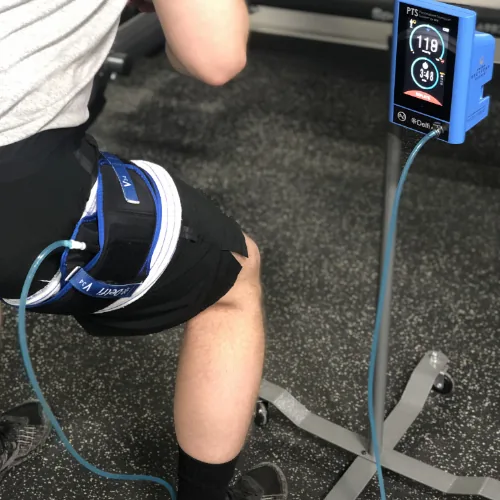
We are also one of the few therapy providers in the Dallas area offering blood flow restriction therapy. A cuff on the limb restricts blood flow from the working muscle, so it works hard at light loads. That keeps strength work going when a knee or a tendon cannot take heavy weight yet.
Five signs a weekend athlete should book a visit
You do not need a scan or a diagnosis to decide. These five are the ones that matter, and any one of them is enough:
- It keeps coming back. The same calf, elbow or back flares each time you return to full volume. Rest calms it; rest does not change why it happened.
- You have started moving around it. A shorter stride, a different grip, a changed stance, skipping the overhead. Once an ache changes how you move, something else starts doing its work.
- It has outlasted two or three weeks of sensible changes. You cut the load, and it is no better.
- You are coming back. After an injury, a surgery or simply months off, the pain often settles long before strength and control return.
- Your load is about to jump. A first pickleball season, a first half marathon, a golf trip with a round every day. Tendons in particular need time to adapt.

None of the five requires you to compete. If you have no season and no coach, only a weekly routine you like and an ache in the way of it, the version built for you is physical therapy for active adults. The toolkit is the same.
What about coming in with no pain at all? A screen is most useful before pain starts, while a stiff joint or a weak side is still only a limitation. It is also the visit with the least certain return, because no screen predicts every injury. What it checks is in what a pre-season injury prevention screen checks.
When it is not worth the money
Some people who call us should keep their money, and we tell them so. A sports physical therapist is usually not worth paying for when:
- It is ordinary soreness. Soreness after unaccustomed exercise peaks at 24 to 48 hours, affects the whole muscle, feels dull and improves with gentle movement. An injury tends to be sharper, in one spot, and present during the activity itself.
- It is new and already improving. A useful rule: mild pain during exercise is acceptable if it settles within a day and the next morning is no worse. The full version is in when you can train through pain.
- Your insurance does the job. With strong in-network benefits, a low copay, a met deductible and a simple problem, an in-network clinic may be the better value. The comparison is in is cash-pay physical therapy worth it.
- You want a rubdown. Passive treatment with no strength work feels good and does not hold.
- You expect one session to replace a training plan, or you are looking for supplement or nutrition advice. Neither is what this is.
- The cost would stop you finishing. A plan you abandon halfway is worse value than a cheaper one you finish.
A separate group should not be deciding between therapy and waiting at all. A joint that swells within hours, a knee that gives way or locks, a calf that felt struck from behind, numbness or weakness, or pain that is constant, worse at night and unrelated to what you did: those need a physician first, some of them the same day. Tell us at the discovery visit and you will be pointed to the right place.
What it looks like for pickleball, golf, running and lifting
The examination changes with the sport, and so does what you get out of it.
Pickleball. Most injuries come from the sudden jump in load when a new player is on court several times a week, and calf and Achilles problems cluster in the first month. A visit measures calf endurance, single-leg balance and hip strength, and you leave with a short program and a sensible number of sessions a week. More in pickleball injuries: what actually turns up.
Golf. Low back pain is the most common complaint in golfers, and the usual cause is a stiff lead hip and mid-back that push the swing’s rotation into the low back. The work is on hip and thoracic rotation, and most golfers keep playing in the meantime. See golf and back pain; for a sore elbow, tennis and golfer’s elbow treatment.
Running. Whether your miles are on the Katy Trail or around White Rock Lake, hips, knees and ankles are tested under load, one leg at a time. Load is modified, not removed, and most runners keep running in some form. Our physical therapy for runners page has the detail.
Lifting. The job is to find what the lift is irritating and adjust the program instead of stopping it, then rebuild to full load. See physical therapy for weightlifters.
Weekend leagues. Basketball, soccer and other court and field sports ask for landing, stopping and cutting, so after an injury those are tested before you play again. The tests are in return to sport after an injury.
What it costs at our Dallas clinic
The published packages are below. A plan is built after the examination, not before it, and nobody is sold a block before a plan exists.
| Option | Cost | Suits you when |
|---|---|---|
| Free discovery visit | No charge | You are not sure this is a therapy problem, or whether the approach fits |
| Single 60-minute session | See sessions & packages | You want one question answered: a check before a new sport or an event |
| 30-minute dry needling | See sessions & packages | A muscle you already know tightens, before a race or after a heavy week |
| 6 visit pain/movement plan | $840, which is $140 a visit | A current problem: reduce pain, restore movement, build strength and performance |
| 12 visit performance package | $1,560, which is $130 a visit | Ongoing wellness, mobility and preventative care once you are back |
How to read this table: start at the top row, which costs nothing, and move down only as far as your problem needs. The per-visit figures are simple arithmetic from the published package prices, and both packages are discounted against single sessions. They are a way to pay for visits, not a promised return date.
The practice is an out-of-network provider: you receive a superbill after every session to file with your insurance for potential reimbursement. How many visits a problem takes depends on what it is and how long it has been there; see how many physical therapy visits you will need. The shorter needling visit is explained in the 30-minute dry needling session.
The comparison that matters is the cost of a plan against the weeks of your sport you would otherwise lose. An hour every few weeks is a small cost against a six-week layoff in the middle of a season. For a weekend athlete the season is whatever you would miss: the fall league, the spring rounds, the race you already entered.
How to get your money’s worth from a visit
What you do around the visits decides most of the value. Five habits make the difference:
- Come early. Problems seen at three weeks take fewer sessions than the same problems seen at three months, because by then there is lost strength and avoidance on top of the original issue.
- Bring your week. What you play, how often, what changed in the last month, and any date on the calendar. Wear what you can move in.
- Ask what should change, and by when. A good plan names that, so you can tell early whether it is working.
- Do the program. Most of the change happens in the days between visits. You leave each one with exercises and self-mobilization to do on your own.
- Expect to be seen less over time. The typical client starts at one to two visits a week, and the plan runs until the result holds on its own.
Once you are back, the goal shifts from treating to keeping. The habits that do that are in staying active after 40 without getting hurt.
Why recreational athletes come to this clinic
Dr. Brent Lockett, PT, DPT holds a Diploma in Osteopractic and is certified in dry needling, spinal manipulation and blood flow restriction therapy. His own interest in physical therapy began as an injured young athlete trying to get back to basketball, which is why the aim here is the activity you came in for, not just a quieter joint.
- The whole hour, one clinician. Sixty minutes, one-on-one, every visit.
- The whole toolkit in one visit. Manipulation, needling, cupping, instrument-assisted work and BFR, whichever the evaluation says you need, followed by loading.
- Your training is changed, not stopped, wherever that is safe.
- You are told when it is not a therapy problem. Differential diagnosis is part of the post-doctorate osteopractic training, so that call can be made at the first visit.
- You are told when it is not worth your money. That is what the free discovery visit is for.
The practice has a 5.0 rating from 81 Google reviews, which you can read on its Google profile before you decide.
How to start: discovery visit, referral and where you are seen
Start with the free discovery visit. It is a conversation, not a sales appointment: what you play, what is getting in the way, what you have tried, and whether this approach suits the problem.
No referral is needed to start: Texas allows up to 30 days of treatment without one, and continuing past that needs a referral. The full rule is in do you need a referral for physical therapy in Texas.
Most clients come to the clinic at 10670 North Central Expressway, Suite 110, in North Dallas, near the Park Cities and Preston Hollow. Visits at your home, office or gym are available across Dallas and the surrounding areas for an upcharge, and a gym visit means the movement can be tested on the equipment you actually use. See mobile physical therapy.
Call (214) 600-7762 or book a free discovery visit. Tell us what you play, how often, and what is on the calendar.
Questions people ask
Is a sports physical therapist worth it for a weekend athlete in Dallas?
Yes, when a pain keeps coming back, has changed how you play for more than two or three weeks, or you are returning after an injury or starting a new sport. For ordinary soreness that fades in a few days it usually is not. Osteopractic Physical Therapy & Pain Relief in North Dallas offers a free discovery visit to find out which applies to you.
Do I have to compete to see a sports physical therapist?
No. The same examination and treatment are used for adults who lift, run, golf or play pickleball for enjoyment. The plan is built around your week instead of a competition season.
How much does sports physical therapy cost at your Dallas clinic?
The published packages are a 6 visit pain/movement plan at $840 and a 12 visit performance package at $1,560, which is $140 and $130 a visit. Single sessions and a 30-minute dry needling session are also available; see the sessions and packages page. The discovery visit is free.
Does insurance cover sports physical therapy here?
The practice is an out-of-network provider. You receive a superbill after every session to file with your insurance for potential reimbursement, which depends on your own out-of-network benefits.
Is one visit enough for a weekend athlete?
Sometimes, for a check before a new sport or an event. A single session does not replace a training plan, and a current injury usually needs a plan. You get an estimate, with the reasoning, after the examination.
Can I keep playing while I am being treated?
Usually, yes. Most aches in active adults respond to changing the load, not stopping, so the plan adjusts what you do. Sharp pain, swelling, giving way, locking, numbness or weakness mean stop and get it assessed.
Should I see a doctor or a sports physical therapist first?
For most aches and overuse problems you can start with a physical therapist. A joint that swells within hours, gives way or locks, a pop or tearing feeling, numbness or weakness, or constant pain at night needs a physician first.
Do I need a referral for sports physical therapy in Texas?
Not to start. Texas allows up to 30 days of treatment without a referral, and continuing past that needs one. Some insurance plans have their own rules.
Can you see me at my gym or home in Dallas?
Yes. Visits at your home, office or gym are available across Dallas and the surrounding areas for an upcharge. Most clients come to the North Dallas clinic at 10670 North Central Expressway, Suite 110.