
The short answer
A safe return to running uses criteria rather than dates: pain-free walking, pain-free hopping, and strength close to the other side. Then walk-run intervals every other day, increasing total volume by around ten percent a week, with speed and hills added last. In Dallas, Dr. Brent Lockett, PT, DPT tests those criteria and builds the return plan one-on-one at the North Dallas clinic.
- Enter on criteria — pain-free walking and hopping, strength close to the other side — not on a date.
- Walk-run intervals every other day, increasing the running portion before the frequency.
- Add speed and hills last, and only one at a time.
- Weeks three and four feel best and carry the highest re-injury risk, so write the plan before you feel good.
The two ways to get this wrong are starting too early and progressing too fast, and the second is more common than the first.
Criteria, not dates
Tissue heals on its own timeline, and people vary. A date on a calendar tells you how long it has been, not whether you are ready.
So the entry point is a set of things you can demonstrate: walking without pain, hopping without pain, and a strength number.
The advantage is that it removes the argument. Either you can do twenty single-leg heel raises or you cannot.
It also gives you something to work on while you wait, which is better for morale than counting weeks.
The entry tests
Thirty minutes of brisk walking with no pain during or after.
Ten single-leg hops on the affected side, controlled, without pain.
Strength close to the other side in the relevant muscle group — calf for foot and Achilles problems, quadriceps for knee, hip abduction for lateral hip and patellofemoral.
No swelling, no limp, and full range of motion.
If you fail one, that is your program for the next two weeks.
| Stage | What you do | Move on when |
|---|---|---|
| Entry tests | 30 minutes brisk walking, 10 single-leg hops, strength check | All pass with no pain, swelling or limp |
| Walk-run | 1 minute run, 2 minutes walk, 8 to 10 minutes of running total, every other day | No symptoms the next morning |
| Longer intervals | 1:2, then 2:2, then 3:1, then 4:1 | Each stage passes the next-morning check |
| Continuous easy running | Conversational pace, volume rising about ten percent a week | Several weeks pain-free at your target volume |
| Hills, then speed | Hills first, then strides, then intervals, one at a time | No setback for a week or two at each step |
| Setback | Drop back one stage and hold for a week | Two setbacks at the same stage: get reassessed |
How to read this table: the right-hand column decides, not the calendar. Judge every stage by how you feel the next morning rather than during the run, and keep the strength work going alongside every row.
Week one back
Walk-run intervals, every other day, three sessions in the week.
A typical start: one minute running, two minutes walking, repeated until you have run for a total of eight to ten minutes.
Flat, forgiving surface. No hills, no speed, no trails.
Judge it by the following morning, not by how it felt at the time. That rule governs the entire progression.
Weeks two to six
Increase the running portion of the intervals before increasing the number of sessions.
A workable sequence: 1:2, then 2:2, then 3:1, then 4:1, then continuous. Move on only when the previous stage produced no symptoms the next morning.
Total weekly volume rises by about ten percent, which is slower than it feels and faster than it looks.
Keep every run easy. Conversational pace throughout this phase, without exception.
When to add speed and hills
After several weeks of consistent, pain-free continuous running at your target volume.
Add one, not both. Hills first for most people, because the loading is more controlled than a track session.
Then strides, then intervals, then hill repeats.
These are the highest-load elements of running and they belong at the end. Adding them in week three is the single most common cause of the second injury.
Why the third and fourth week is dangerous
Pain has resolved, running feels easy, and the temptation to jump ahead is at its strongest.
Meanwhile the tissue has had only two or three weeks of loading, which is not enough for meaningful adaptation.
So capacity and confidence are furthest apart at exactly the point where people make the decision to accelerate.
Writing the plan down in advance, before you feel good, is the practical defense against this.

Strength work continues throughout
Two sessions a week, all the way through the return and afterward.
Calf work for anything below the knee. Quadriceps and hip for anything above it. Both, ideally.
The strength should keep progressing while the running volume rises, not stop because running has resumed.
This is the part almost everybody drops, and it is the part that determines whether next season is different.
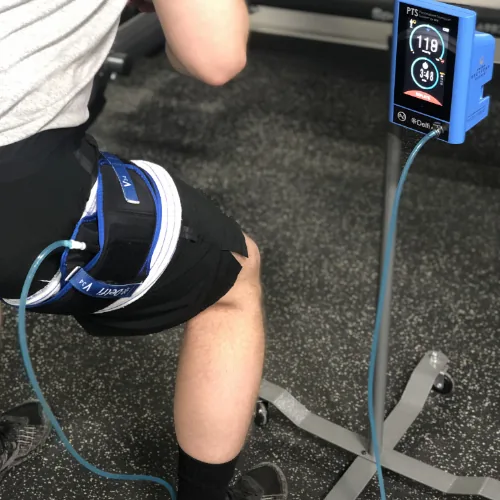
That is how blood flow restriction therapy fits into a return, and the knee side of it is on the runner’s knee page.
Cadence, and the one running change worth making
Increasing step rate by about five to ten percent reduces load at the knee and the tibia, and it is one of the few gait modifications with consistent support.
Use a metronome app or a playlist at the target tempo for the first few weeks. It becomes automatic quickly.
It works by shortening the stride slightly, which reduces the braking force at each contact.
Beyond that, deliberate form changes are usually not worth the effort. Strength and progression do more.
Surfaces and shoes
Softer surfaces reduce peak impact and are worth using early in a return, though the evidence for surface choice preventing injury is weaker than the intuition suggests.
Consistency matters more than the surface itself. Alternating between very different surfaces is more provocative than staying on one.
Do not change shoes during a return. One variable at a time.
If a shoe change is planned, phase it in over several weeks once you are running consistently again.
Cross-training while you build
Cycling, swimming, deep-water running and the elliptical all maintain aerobic fitness without impact.
Deep-water running is the closest specific substitute and is worth the tedium for anyone facing a long layoff.
Keep some of it going during the early return, so total training load stays reasonable while running volume is low.
Then taper it as running increases, rather than stacking both at full volume.
What a setback looks like and what to do
Symptoms that are worse the following morning than they were the previous day.
Drop back one stage, hold there for a week, and progress again. That is usually the whole response.
A setback is not a failure of the plan; it is the plan working, because it caught the problem at two weeks rather than at three months.
Two setbacks at the same stage means something in the underlying capacity has not been addressed, and that is the point to have it reassessed.
A worked example
Take a runner who was doing thirty miles a week before a calf problem and has been off for six weeks.
Week one: three sessions of ten minutes running, broken into one-minute intervals. Roughly two miles for the week.
Weeks two to four: intervals lengthen, sessions stay at three a week, weekly volume reaches perhaps six to eight miles.
Weeks five to eight: continuous easy running, volume climbing about ten percent a week, reaching fifteen to eighteen miles.
Weeks nine to twelve: back toward thirty, with strides and then hills introduced. That is a twelve-week return from a six-week layoff, and it is the normal shape rather than a cautious one.
What to do about races in the diary
Be honest about the arithmetic early. A twelve-week return does not fit into a six-week gap before a marathon, and deciding that in week two is far less painful than deciding it in week eight.
Downgrading the distance is usually a better option than compressing the plan.
If the race genuinely cannot move, the honest conversation is about what level of risk you are accepting and what the likely cost is afterward.
That is your decision to make. What is not reasonable is making it without anyone saying the arithmetic out loud.
Sleep, fuel and the rest of the load
Running volume is one input. Sleep, work stress, other training and food are the others, and tissue responds to the sum rather than to the running alone.
A week with four hours of sleep a night is not a week to progress the plan, whatever the schedule says.
Under-eating during a return is common, because people cut back when they are training less and then do not restore it as volume climbs. Bone and tendon both need the fuel to rebuild.
This is why two identical training weeks can produce completely different responses, and why the next-morning check is more reliable than the plan on paper.
Coming back from different injuries
Bone stress injuries are the most conservative: they need the full layoff first, and the return is slower because bone adapts slowly.
Tendon problems tolerate more early running, often at reduced volume throughout, with the morning stiffness rule governing progression.
Muscle strains allow a faster return but need the strength benchmark met properly, because reinjury rates are high and are driven by exactly that gap.
Joint problems vary most, and the entry criteria matter more than the timeline. Swelling that returns after a run is the signal to hold, regardless of how the pain felt.
For the first two, see shin splints or stress fracture and Achilles pain: load, not rest.
Tracking it in a way that helps
Record three things per session: total running minutes, how it felt during, and how it felt the next morning.
The third column is the one that matters and the one nobody keeps.
Reviewing it every two weeks shows you the pattern before it becomes a setback — two or three mornings creeping upward is a signal to hold, not to push.
It also makes the reassessment conversation useful rather than a matter of recollection.
The things that predict a good return
Strength at or near the benchmark before starting.
A written progression rather than an intention.
Judging by the next morning rather than by the run itself.
And enough patience for the timeline, which for a significant injury is usually eight to twelve weeks from first run to full training.
The people who get this wrong are almost never lazy. They are the ones who feel good in week three and act on it, which is why the plan needs to be written down before that week arrives.
Testing the entry criteria and writing the plan is part of sports performance therapy at 10670 North Central Expressway, Suite 110.
Questions people ask
How do I know I am ready to run again after an injury?
Thirty minutes of brisk walking with no pain during or after, ten controlled single-leg hops without pain, no swelling or limp, full range of motion, and strength close to the other side.
How fast can I increase running after an injury?
Lengthen the running intervals before adding sessions, and judge each step by how you feel the next morning. Add volume in small steps, and add hills and speed last.
Why do I get hurt again a few weeks after coming back?
Pain settles before the tissue has adapted, so weeks three and four feel easy while capacity is still low. Writing the plan down before you feel good is the best defense.
Should I keep doing strength work once I am running again?
Yes. Two strength sessions a week through the return and afterward is what decides whether the injury comes back.
Who can help me return to running in Dallas?
Dr. Brent Lockett, PT, DPT tests the entry criteria and builds the return plan one-on-one at 10670 North Central Expressway, Suite 110. Call (214) 600-7762.