The short answer
Pain just below the kneecap that is worst when you jump, run, squat or kneel is usually patellar tendon pain, often called jumper’s knee. Rest calms it for a while but does not fix it, because tendons respond to progressive load, not to rest. In Dallas, Dr. Brent Lockett, PT, DPT treats it one-on-one at 10670 North Central Expressway, Suite 110.
- Pain just below the kneecap, worst with jumping, landing, running, squatting or kneeling, is usually patellar tendon pain (jumper’s knee).
- Rest calms the tendon but costs capacity and strength; tendons respond to progressive load, not to rest.
- Dose the load by the traffic-light rule and judge it by the next morning: same or better means the load was right.
- Blood flow restriction builds thigh strength with light weights while the tendon is too irritable for heavy squats.
- A knee that locks, gives way, swells fast after an injury or is red and hot needs a physician first. No referral needed to start therapy: Texas allows up to 30 days without one.
It usually starts small. A twinge just below the kneecap on the first few jumps of a pickup game, at the start of a run, or at the bottom of a squat. It warms up and fades, so you keep going. Then it starts to hurt afterward too, on the stairs the next morning or when you stand up from a low chair. You take a week or two off, it feels fine, and the first hard session back brings it straight back.
That cycle is the signature of patellar tendon pain, and the week off is part of why it keeps coming back. Below: how it differs from runner’s knee, why rest does not fix it, how load is dosed, what treatment at our North Dallas clinic combines, and which knees need a physician first.
What patellar tendonitis is
The patellar tendon is the thick band that runs from the bottom of the kneecap to the bony bump at the top of the shin. Every time you jump, land, run, squat or climb stairs, the big muscles on the front of your thigh pull on the kneecap, and that force passes through this tendon. In a jumping sport it takes that load hundreds of times a game.
Patellar tendon pain is a load problem: the tendon is being asked to do more than it can currently handle. It usually follows a change: a new season, a jump in training volume, more games in a week, a new program with deep squats, or a return to sport after a long break. It is the classic complaint of basketball and volleyball players, which is where the name jumper’s knee comes from, but runners, lifters and people who kneel a lot get it too.
The word “tendonitis” suggests inflammation. In a tendon that has been sore for weeks or months there is little of it, which is why anti-inflammatory medication and ice ease the pain without changing the course. Clinicians often say tendinopathy instead. Whatever the name, what helps is the same: rebuilding what the tendon can tolerate.
Jumper's knee, runner's knee or the quadriceps tendon?
Front-of-knee pain has more than one source, and they are treated differently. The quickest clue is exactly where it hurts:
| Problem | Where it hurts | What usually brings it on | What the plan centers on |
|---|---|---|---|
| Patellar tendon (jumper’s knee) | Just below the kneecap, often a spot you can press on | Jumping, landing, running, deep squats, kneeling | Progressive tendon loading while jumping or running volume is managed |
| Kneecap (runner’s knee, patellofemoral pain) | Around or behind the kneecap, harder to point to | Stairs, squats, hills, sitting with the knee bent | Hip and calf strength, training load, how you land and run |
| Quadriceps tendon | Just above the kneecap | Jumping, running, kneeling, heavy squatting | The same load-based approach as the patellar tendon |
| Needs a physician first | Anywhere, after a pop, a twist or a fall | A sudden injury rather than a gradual build-up | Medical assessment, sometimes imaging, before therapy |
How to read this table: find the row that matches where you would put your finger. A tendon usually hurts in one small spot and is worst with jumping and landing; kneecap pain is more of a spread-out ache that stairs and sitting bring on. The last row overrides the rest, because a sudden injury is a different problem.
In real knees these overlap. A jumper can have a sore tendon and an irritable kneecap at the same time, and a weak or stiff hip often feeds both. That is why the examination tests the knee under load rather than relying on where it hurts. Kneecap pain has its own page: runner’s knee treatment.

Why rest calms it but rarely fixes it
Rest works in the short term, and that is what makes it so convincing. Take the jumping away and the tendon quiets down. The trouble is what happens underneath: a tendon that is not loaded loses capacity, and the thigh muscles that protect the knee lose strength. You come back with less tendon and less muscle than you left with, into the same demands that overloaded it in the first place.
Tendons respond to progressive load, not to rest. That line is on our knee pain treatment page for a reason. Given the right dose, a tendon adapts and gets more tolerant. Given none, it does the opposite. The same principle runs through our article on Achilles pain: load, not rest; the knee tendon behaves the same way.
This does not mean playing through anything. The painful activity is dosed rather than banned: a short spell with less jumping or lighter running while the tendon is loaded with specific strength work, then jumping and running come back in stages. Complete rest is the version that keeps the cycle going.
How much pain is acceptable while you load it
Tendon rehab is not pain-free, and it should not be painful in a way that builds session after session. The rule we use is simple enough to run yourself, and it is the same traffic-light rule set out in training through pain:
- Green, up to about three out of ten during the exercise. Continue as planned.
- Amber, four to five out of ten. Acceptable, provided it settles within twenty-four hours and the next morning is no worse.
- Red, six or more, sharp, or worsening as you go. Stop that exercise and change something.
The next morning is the best judge. Check the knee on the stairs or with a simple squat the morning after a session. Same or better: the load was right. Worse: the last session was too much, so reduce it by about ten percent, not to zero. Swelling, giving way or locking are not part of the traffic light; they mean stop and get the knee assessed.
How the load is built, stage by stage
A tendon plan moves through stages, and each one is earned by passing a test, not by a date on the calendar. How long you spend in each depends on how irritable the tendon is, how long it has been sore and what your sport asks of it:
| Stage | What the work looks like | Move on when |
|---|---|---|
| 1. Settle | Jumping and running dosed down, not stopped; steady holds and light thigh work, with blood flow restriction if heavier loading flares the knee | Pain during the work stays green or amber and the next morning is no worse |
| 2. Strength | Slow, heavier squats, leg press and split squats, building load session to session; hip and calf strength alongside | Heavier, slower work is tolerated without the next morning getting worse |
| 3. Speed and spring | Faster movements, small hops and skips, landing practice, the first easy runs back | Low-level hopping and landing pass the next-morning test |
| 4. Back to sport | Full jumping, cutting, running volume or lifting, rebuilt in steps | Strength, hops and landing compare well with your other leg |
How to read this table: the right-hand column is the gate. If the knee is worse the morning after a stage, you stay there or step back, rather than pushing on because a week has passed. Most setbacks happen when the speed and spring stage is skipped, because a tendon that can squat heavy is not yet a tendon that can land from a jump.
Throughout, your sport is dosed rather than taken away: shooting and skill work for a player, shorter and flatter runs for a runner.
What treatment here combines
Every visit is 60 minutes, one-on-one with Dr. Lockett, never handed to an aide. A typical hour for a sore patellar tendon puts these pieces together:
- Examination of the knee, hip and ankle under load. A single-leg squat, a step-down, how you land. A hip that lets the knee drift inward or an ankle that does not bend far enough hands the tendon extra load, and treating only the knee is why so much knee pain comes back. More in hip and knee pain are connected.
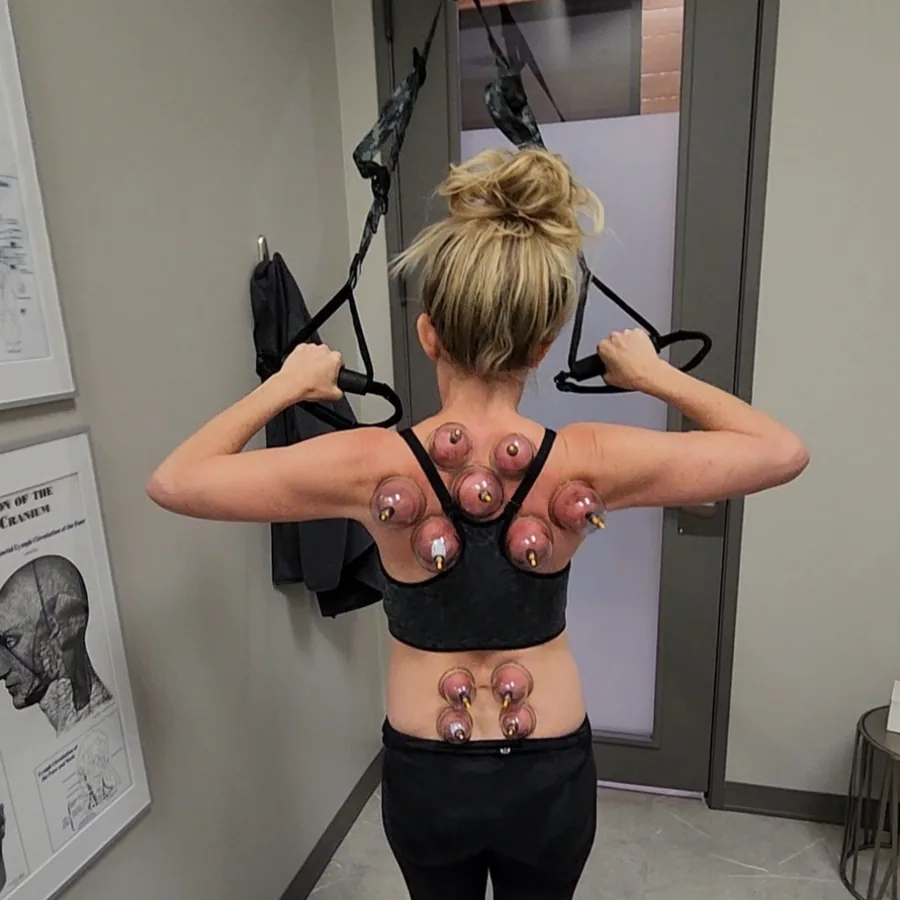
- Manual work. Joint mobilization where the knee or ankle is stiff, and soft tissue and instrument-assisted work on the tissue around the knee.
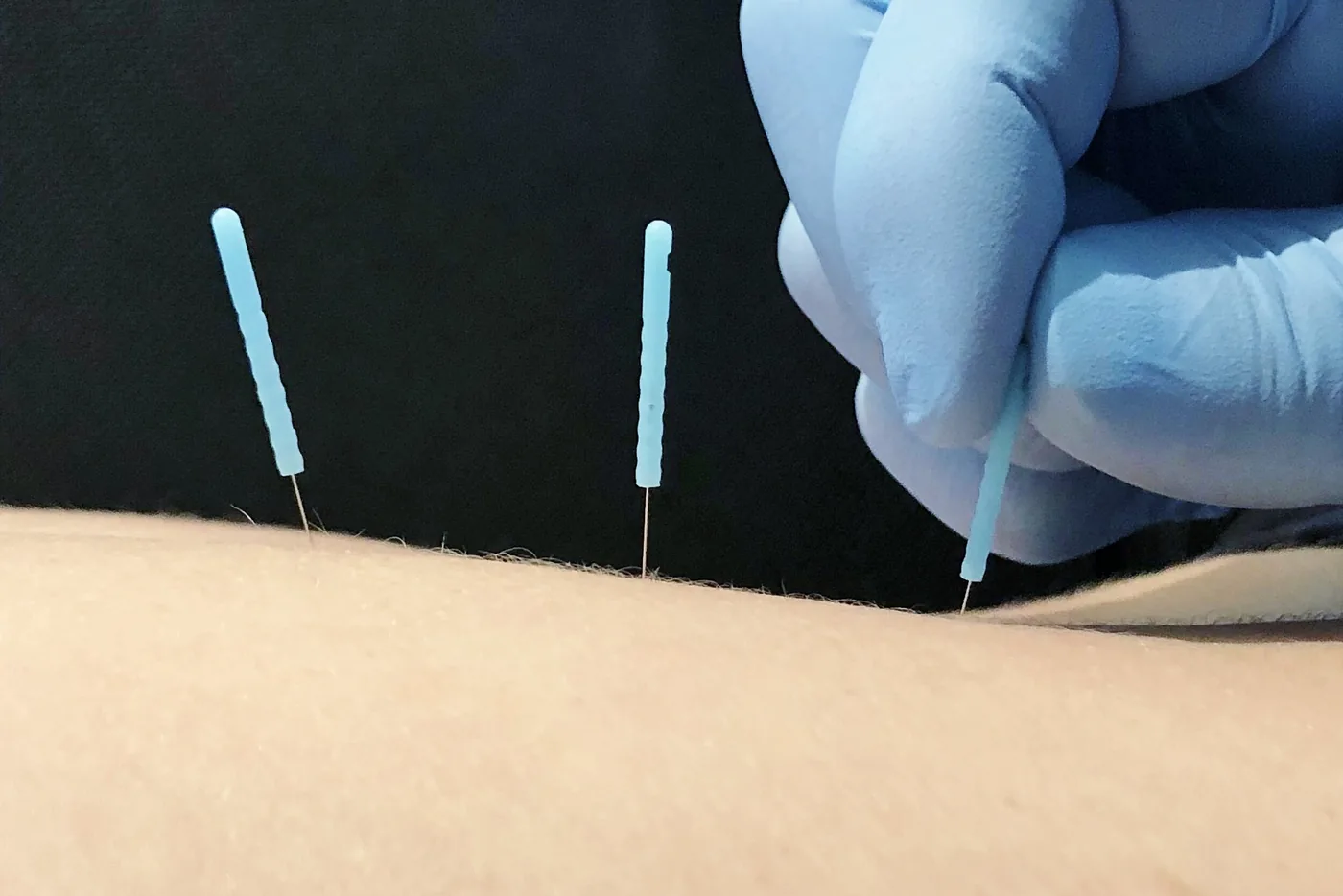
- Dry needling for trigger points in the quadriceps, hamstrings, calf and hip muscles that pull the knee out of its easy path. Needling releases the muscle; the strength work that follows is what makes it hold.
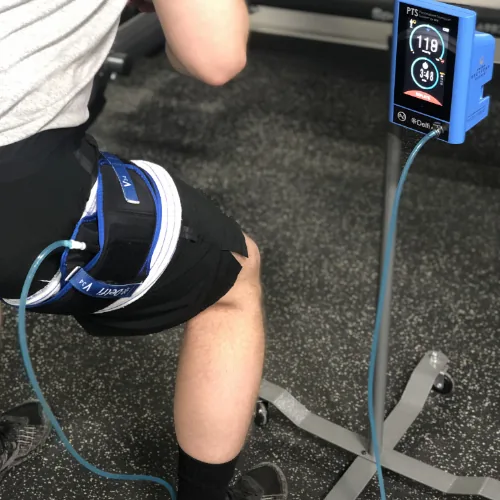
- Strength with light loads. Blood flow restriction lets the thigh work hard at weights a sore tendon will tolerate, so the muscle keeps building while the tendon settles.
- A plan you run between visits. The exercises, the dose and the next-morning check, so the tendon is loaded on the days you are not here.
The typical plan is one to two visits a week until the result holds. You get an honest estimate after the examination, not before it.
Blood flow restriction: strength without a flare
The central problem in tendon rehab is that the muscle needs load to get stronger, and heavy load is exactly what the sore tendon cannot take yet. Blood flow restriction therapy is how you get out of that bind.
A cuff is placed around the top of the thigh and inflated to a pressure set for you and that leg. You then exercise with light weights, in structured sets with short rests. The muscle fatigues and works far harder than the weight suggests, while the tendon only sees a light load. It burns, and it lets the thigh build strength in the stage where heavy squats would flare the knee.
It is a bridge, not a destination. As the tendon tolerates more, load moves back to conventional strength work and the cuff comes out less and less. Your history and any vascular or clotting risk factors are reviewed first; certain histories rule it out, and you will be told. Dr. Lockett is certified in blood flow restriction therapy.
Getting back to jumping and running
Being pain-free is not the same as being ready. A tendon that feels fine walking around can still flare on the first full-speed game, which is where most comebacks from jumper’s knee go wrong.
So the return is tested, side to side. Strength of the thigh, hip and calf on the sore leg is compared with the other leg. Single-leg hops for distance and control are compared the same way. Landing and cutting are watched for the knee collapsing inward or the trunk leaning. And because fatigue changes how you land, it matters how the knee behaves late in a session, not only when you are fresh. The full process is in basketball injuries and the road back to the court.
For runners the return is a staged build of volume, with hills and speed added back last. For lifters, depth, tempo and volume of squats come back step by step. This testing is the core of sports performance therapy here.
Who should see a physician first
Patellar tendon pain builds gradually. A knee that was injured suddenly is a different problem. See a physician first, before any therapy, if:
- your knee locked and will not straighten;
- it gives way repeatedly;
- it swelled within hours of an injury;
- you felt a pop with sudden pain and then could not straighten the leg or take your weight on it;
- it cannot take your weight;
- it is red, hot and swollen, especially with a fever.
Calf pain and swelling, especially after surgery or a long flight, needs urgent medical care. And in growing players, pain just below the kneecap is often related to growth plates and training load during a growth spurt. It usually settles with sensible load management and strength work, but pain that is severe, getting worse or comes with swelling should be assessed, and it is a reason to look at how many teams and practices a young player has each week.
Differential diagnosis is part of Dr. Lockett’s post-doctorate osteopractic training, so “this needs a physician” is an answer you can be given at the first visit.
Jumper's knee in Dallas: courts, trails and gyms
Most of the patellar tendons we see in Dallas belong to people who changed something. Adult league and pickup basketball after years away. Volleyball and pickleball on hard courts several times a week. Runners building mileage for a fall race on the Katy Trail or around White Rock Lake. Lifters who added deep squats or jumping work to a program. Parents watching a teenager play on school, club and travel teams at once. Related reading: runner’s knee is preventable and pickleball injuries.
Treatment happens where it is most useful. Most clients come to the clinic at 10670 North Central Expressway, Suite 110, in North Dallas. Visits at your home, office or gym are available across Dallas and the surrounding areas for an upcharge, which helps when you want the landing and squatting tested on the court or equipment you actually use. Live video sessions are offered too, useful for checking your exercise dose between visits.
Cost, insurance and referral
- Free discovery visit: No charge — a conversation about your knee and whether this approach fits
- 6-visit pain/movement plan: $840 — six 60-minute, one-on-one visits
- 12-visit performance package: $1,560 — twelve 60-minute visits, for ongoing performance and preventative care across a season
- Single sessions: see sessions & packages
The practice is an out-of-network provider. You receive a superbill after every session to file with your insurance for potential reimbursement under your out-of-network benefits.
No referral is needed to start: Texas allows up to 30 days of treatment without one. The full rule is in do you need a referral for physical therapy in Texas. Call (214) 600-7762 or book the free discovery visit online, and bring the jump, run or lift that hurts. That is what the plan is built around.
Questions people ask
Patellar tendonitis treatment in Dallas
Osteopractic Physical Therapy & Pain Relief in North Dallas treats patellar tendonitis (jumper’s knee) one-on-one with Dr. Brent Lockett, PT, DPT, in 60-minute visits: an examination of the knee, hip and ankle, manual work, dry needling, progressive tendon loading and blood flow restriction strength work. No referral is needed to start.
Does rest fix patellar tendonitis?
Rest usually calms it for a while, but the pain tends to return when you go back, because an unloaded tendon loses capacity. Tendons respond to progressive load. The painful activity is dosed rather than stopped.
How do I know if it is jumper's knee or runner's knee?
Jumper’s knee usually hurts in one spot just below the kneecap, worst with jumping and landing. Runner’s knee is an ache around or behind the kneecap, brought on by stairs, squats and sitting. They can overlap, which the examination sorts out.
Can I keep playing basketball with jumper's knee?
Often in a reduced form. Full-speed jumping volume is usually limited for a while and skill work continues, while the tendon is loaded with strength work. Jumping then comes back in stages.
Can I keep running with patellar tendon pain?
Usually, with less volume and fewer hills and speed sessions. Use the next-morning rule: if the knee is worse the morning after a run, the run was too much.
Should I ice or take anti-inflammatories for patellar tendonitis?
They can ease the pain, but a tendon that has been sore for weeks has little inflammation, so they do not change the course. Loading does. Ask your physician about any medication.
How long does patellar tendonitis take to heal?
It depends on how irritable the tendon is, how long it has been sore and what your sport asks of it. Tendons adapt slowly. You get an honest estimate after the examination.
Does a knee strap help jumper's knee?
Some people find a strap below the kneecap eases pain during play. It can be a short-term help, but it does not build the tendon’s capacity; the loading program does.
When should I see a doctor for pain below the kneecap?
If the knee locked, gives way, swelled within hours of an injury, cannot take your weight, is red and hot, or you felt a pop and then could not straighten the leg. Those need a physician before therapy.