The short answer
Most degenerative rotator cuff tears do well with progressive strengthening, and trials comparing repair with exercise find similar outcomes at one to five years for many patients. Acute traumatic tears in younger people, and tears with genuine loss of function, are the ones with a clearer surgical case. In Dallas, Dr. Brent Lockett, PT, DPT measures what your shoulder can do before you decide.
- Rotator cuff tears are common on imaging in people with no shoulder pain, and rates rise steeply with age.
- For degenerative tears, trials find structured exercise produces outcomes comparable to repair at one to five years.
- Acute traumatic tears with sudden weakness, and shoulders that cannot hold the arm up, have a clearer surgical case.
- Twelve weeks of supervised, progressive loading is what the trials tested — not a sheet of band exercises.
A scan report saying full-thickness tear is frightening in a way the words do not quite deserve. The number of people walking around with exactly that finding and no symptoms at all is the first thing worth knowing.
How common tears are in people without pain
Studies imaging shoulders in people with no complaint find rotator cuff tears in a substantial minority, and the rate climbs steeply with age.
By the seventh decade, a large share of pain-free shoulders show cuff tears on imaging. By the eighth, it is higher still.
That does not mean tears never matter. It means the presence of one on a scan does not establish that it is causing your symptoms.
Two kinds of tear
Degenerative: developing gradually, usually after forty, often without a specific incident. The tendon has worn rather than snapped. These are the majority.
Traumatic: a specific event, a specific moment, usually a fall or a sudden load, often with immediate loss of function. More common in younger people and much less common overall.
The distinction matters more than the size of the tear, because the two behave differently and the evidence for surgery differs sharply between them.
| Degenerative tear | Traumatic tear | |
|---|---|---|
| How it starts | Gradually, often without a specific incident; the tendon has worn | A specific moment: a fall or a sudden load |
| Who usually has it | Usually after forty; the majority of tears | More common in younger people, much less common overall |
| The arm | Usually can be raised and held, even if it hurts | Often immediate loss of function or sudden weakness |
| What the trials found | Structured exercise and repair gave similar pain and function at one, two and five years | Repairing early tends to give better outcomes than waiting |
| Reasonable first step | Twelve weeks of supervised, progressive loading, then reassess | A prompt surgical opinion, especially under about sixty |
How to read this table: decide which column your story fits before you look at the size of the tear on the report. If you cannot raise or hold the arm, or it started with a fall and sudden weakness, the right-hand column applies and timing matters. If it crept up and the arm still works, the left-hand column is the usual path, and you lose very little by trying it first.
What the evidence says about degenerative tears
Randomized trials comparing surgical repair with structured exercise for degenerative tears have generally found similar pain and function scores at one, two and five years.
The repaired tendons look better on follow-up imaging. The patients do not reliably feel better.
That is an uncomfortable finding and it is reasonably consistent. It is why many surgeons now recommend a proper course of rehabilitation first.
What a proper course means
Twelve weeks minimum, three to four sessions a week, with load that progresses.
Not a printed sheet of band exercises. Measured strength at the start, progression written down, and a reassessment against the same numbers at the end.
The trials that found exercise equivalent to surgery used supervised programs of that quality. A six-week course of unsupervised stretching is not the same intervention and should not be expected to produce the same result.
When surgery has a clearer case
An acute traumatic tear in someone under about sixty, particularly with sudden weakness. Repairing these early tends to produce better outcomes than waiting.
Genuine loss of function — an arm that cannot be raised or held, rather than one that hurts when raised. That distinction is tested easily and it matters.
A tear that has failed a genuine trial of loading, in someone whose function is meaningfully limited.
And certain occupational or athletic demands where the shoulder needs to do more than a rehabilitated cuff is likely to deliver.
What the scan does not tell you
Whether the tear is causing your pain. Shoulders hurt for many reasons, including the neck, and the tear may be an incidental finding of long standing.
How much strength you have. That is tested, not imaged, and it is the number that predicts function.
Whether the tear will get bigger. Some do, some do not, and imaging at one point in time cannot say which.
How you will feel in a year. That correlates poorly with tear size and better with strength and with what you do.
The test that matters most
Can you raise the arm to shoulder height and hold it there against gentle pressure? A shoulder that can do that has a functioning cuff, whatever the scan says.
A shoulder that drops the arm when it is released from an elevated position — the drop-arm sign — is a different situation and warrants surgical consultation.
External rotation strength with the elbow at the side, and internal rotation behind the back, give the rest of the picture.
Ten minutes of that tells you more about what to do next than the report does.
What rehabilitation involves
Early on: pain control, range, and isometric loading, which is well tolerated even by irritable shoulders.
Then progressive resistance for the cuff and the scapular muscles, increasing over weeks rather than sessions.
Then the specific demands you actually have — overhead reaching, carrying, throwing, lifting a grandchild — loaded deliberately rather than avoided.
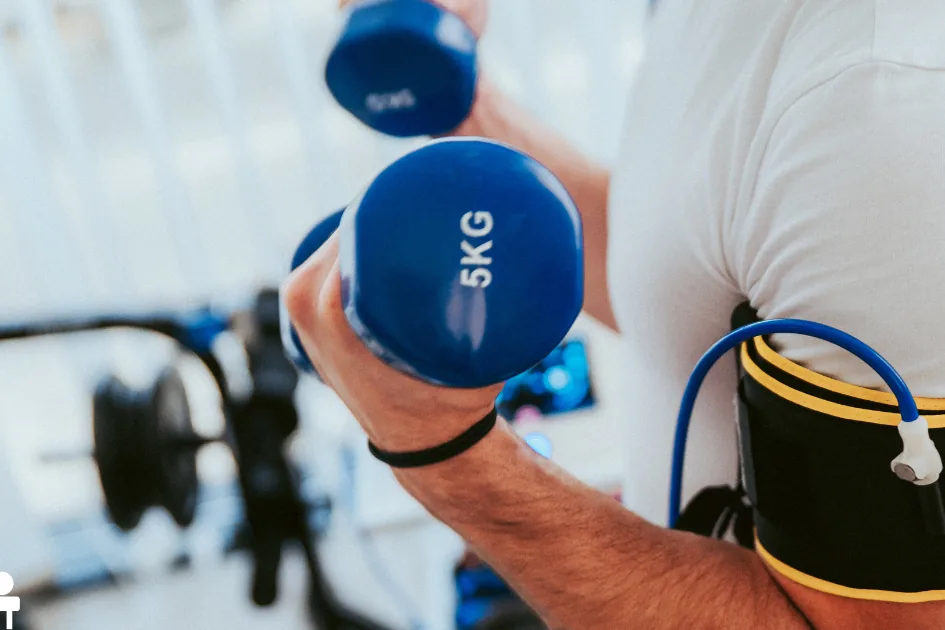
Blood flow restriction training is genuinely useful here for people who cannot tolerate heavy load yet, because it produces strength adaptation at low resistance.

The whole plan for a painful shoulder is on the shoulder pain treatment page.
If you do have surgery
The rehabilitation is longer and stricter than most people expect. A sling for several weeks, passive range only at first, and no active loading of the repaired tendon until the surgeon allows it.
Full return typically takes six to twelve months, and the first three are mostly protection.
Retear rates are not trivial, particularly for large tears and older tendons, and adherence to the protocol is one of the few things within your control. The early weeks are covered in post-surgical rehab: the first six weeks.
So the decision is not surgery versus effort. It is which effort, over what timeline.
A reasonable way to decide
If there was no specific injury and you can raise the arm: do twelve weeks of proper loading first, then reassess. You lose very little by trying, and most people do not need the operation.
If there was a clear injury with sudden weakness, particularly under sixty: get a surgical opinion promptly, because timing affects the result.
If loading has genuinely failed and function is limited: that is what surgery is for, and going in having done the work puts you in a better position postoperatively too.
Age, and why it changes the arithmetic
A tear in a thirty-five-year-old with fifty years of shoulder use ahead is a different proposition from the same tear in a seventy-five-year-old.
Younger tendons repair better, and a young traumatic tear left alone can retract and become harder to fix later. That is the argument for moving promptly in that group.
Older tendons repair less reliably, retear more often, and the surgery is harder on the person. Meanwhile the strengthening route works just as well for most everyday demands.
None of that is a rule about your shoulder. It is why the same scan report leads two surgeons to two different recommendations for two different patients, and why the conversation should include your age, your demands and your goals rather than the tear alone.
Questions worth asking the surgeon
Is this tear consistent with my symptoms, or is it an incidental finding?
What is my measured strength, and how much of my problem is weakness rather than structure?
What is the expected outcome with a proper course of loading first, and what do I lose by trying it?
What does the recovery actually involve, week by week?
A good surgeon welcomes these. Several I work with raise them first.
What blood flow restriction adds here
A cuff that hurts under load presents a genuine problem: strength needs load, and load hurts. Blood flow restriction training resolves part of that.
Working at twenty to thirty percent of maximum with a cuff applied to the upper arm produces strength and size adaptation comparable to much heavier lifting, without the joint loading.
That makes it useful early, when heavy work is not tolerated, and after surgery, when it is not permitted. See blood flow restriction therapy in Dallas and how early BFR can start after surgery.
It is not a replacement for heavy loading later. It is a way of not losing three months while you wait to tolerate it.
What good outcomes look like without surgery
Most people with a degenerative tear who complete a proper program end up with a shoulder that does what they need, with occasional discomfort under heavy or overhead load.
The tear is usually still there. That surprises people, and it stops mattering once the function returns.
Full pain-free overhead capacity is a realistic goal for many and not for everybody, and the honest version of that conversation happens at the start rather than at week ten.
The people who do least well are those who did neither — no surgery and no real loading — and simply stopped using the arm.
What not to do while you decide
Do not stop using the arm. Disuse produces stiffness and weakness on top of the original problem, and both make every option worse.
Do not push into sharp pain repeatedly in the hope of proving something.
Do not let the scan report set the timetable. A tear that has been there for years does not become urgent because you have now read about it.
And do not let a well-meaning relative talk you into a decision on the strength of how their own repair went. Cuff outcomes vary enormously with age, tear type and what the person did afterward, and a single anecdote tells you almost nothing about your own shoulder.
If you want the strength test done before your next appointment with the surgeon, book a free discovery visit or call (214) 600-7762. Visits are 60 minutes, one-on-one, at 10670 North Central Expressway, Suite 110, in North Dallas, and no referral is needed in Texas.
Questions people ask
Can a full-thickness rotator cuff tear heal without surgery?
The tear itself usually stays on the scan, but many people with a degenerative full-thickness tear regain a shoulder that does what they need through progressive strengthening. Traumatic tears with sudden weakness are different and need a prompt surgical opinion.
Which rotator cuff tears need surgery?
An acute traumatic tear with sudden weakness, particularly under about sixty, a shoulder that cannot raise or hold the arm, and a tear that has failed a genuine trial of loading in someone whose function is limited.
How long should I try physical therapy before deciding on surgery?
The trials that found exercise comparable to repair used about twelve weeks of supervised, progressive loading. Reassess against the same measurements at the end.
What is the most useful test for a rotator cuff tear?
Whether you can raise the arm to shoulder height and hold it against gentle pressure. A shoulder that can do that has a functioning cuff, whatever the scan says.
Can blood flow restriction help a rotator cuff tear?
It lets the arm build strength at twenty to thirty percent of maximum load, which helps early when heavy work hurts and after surgery when it is not yet permitted.
Where can I get a rotator cuff assessment in Dallas?
Osteopractic Physical Therapy & Pain Relief, 10670 North Central Expressway, Suite 110, in North Dallas. Sessions are 60 minutes, one-on-one with Dr. Brent Lockett, PT, DPT, and no referral is needed.