The short answer
With your surgeon’s clearance, blood flow restriction (BFR) training can often start in the first weeks after surgery, well before the joint tolerates normal strengthening. It matters because muscle loss after a knee or shoulder operation starts right away, and BFR gives a strength stimulus at light weights a healing repair can handle. Screening comes first. In Dallas, Dr. Brent Lockett, PT, DPT uses BFR in post-surgical rehab.
- Muscle loss begins immediately after surgery, and the fastest loss happens when conventional strengthening is unavailable.
- BFR produces a strength stimulus at a small fraction of normal load, which a protected joint will often accept.
- Timing is a surgical decision, and cuff pressure must be set from your own limb occlusion pressure rather than a fixed number.
- It protects the baseline you rebuild from; it does not speed up tissue healing or let you skip a stage.
- Prehabilitation is the strongest version: strength built before the operation is strength you do not have to rebuild afterwards.
The frustrating part of post-operative rehabilitation is the gap: the joint needs protecting, the muscle needs loading, and for several weeks those two requirements point in opposite directions. BFR is one of the few things that addresses both, which is why it has a place in post-operative rehabilitation.
What happens to muscle after an operation
Atrophy starts immediately and moves quickly. Within the first week or two after a knee operation, quadriceps cross-sectional area and strength both fall measurably, and the strength loss outpaces the size loss because neural drive to the muscle drops as well.
Some of that is disuse and some is inhibition — the nervous system actively reducing its output to a muscle surrounding a swollen, painful joint.
The consequence is that people finish their protected period substantially weaker than they started, and then spend months rebuilding from a lower baseline than necessary. That gap is the problem worth solving.

Why ordinary strengthening cannot fill the gap
Building strength conventionally requires heavy load. A joint two weeks post-operation does not tolerate anything close to that, and forcing it is a good way to inflame everything.
So the standard early plan is isometrics, range of motion and neuromuscular work. Those are worth doing and they do not produce meaningful hypertrophy or strength gain on their own.
That is the bind: the window where atrophy is fastest is the window where the usual stimulus is unavailable.
What BFR does about it
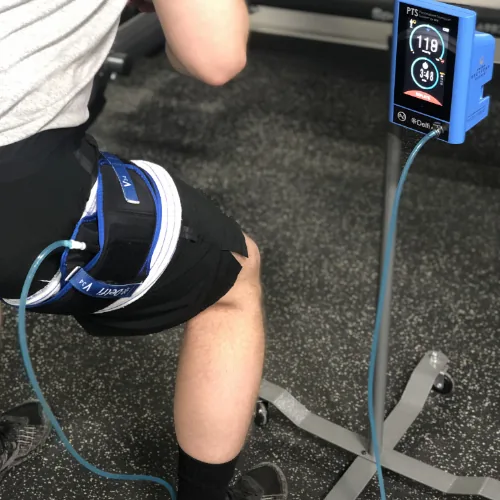
A cuff at the top of the limb restricts venous return during light exercise. The working muscle accumulates metabolites, and the resulting environment produces a strength and hypertrophy signal at light loads, a small fraction of what conventional strength training requires.
That is a load a healing joint will often accept. It means the muscle can be given a genuine training stimulus during the period when the joint is still being protected.
It does not replace conventional strengthening later. It protects the baseline you will be building from, which shortens everything that follows.
How the cuff is set and how sessions run is on the clinic’s blood flow restriction therapy page.
When it can actually start
That is a surgical decision, not a physical therapy one, and it varies by procedure, fixation and surgeon preference. Some protocols permit it within days; others specify a number of weeks.
What is consistent: it starts when the incision is healing appropriately, when there is no sign of infection, when swelling is controlled enough to apply a cuff safely, and when the surgeon has said so in terms that are not ambiguous.
If your surgeon has not addressed it, that is a question worth asking directly rather than assuming either way. Most are familiar with it; some have specific preferences about timing that are worth knowing.
| Checkpoint | Who decides | Why it matters |
|---|---|---|
| Clear clearance for BFR, including from which week | Your surgeon | Timing varies by procedure, fixation and surgeon preference |
| The incision is healing, with no sign of infection | Your surgeon and your therapist | A cuff is not used over infection or an open wound |
| Swelling is controlled enough for a cuff | Your therapist | The cuff has to sit safely on the limb |
| Screening: clots, vascular or cardiac history, blood pressure, lymphedema, pregnancy | Your therapist, with your physician where needed | Any of these can rule BFR out; then the plan is built another way |
| Cuff pressure set for you and that limb | Your therapist | Not one fixed number for everyone |
How to read this table: all five rows have to be true on the day, and the first two are not a physical therapy call. If any row is a no, early rehab still goes ahead without the cuff.
The screening, which is not optional
A cuff restricting venous return has a specific risk profile. History of deep vein thrombosis or other clotting disorders, certain vascular or cardiac conditions, uncontrolled hypertension, active infection, an open wound or lymphedema in the limb, and pregnancy unless your physician has cleared it are all reasons to screen carefully or not proceed.
Recent surgery itself raises baseline clot risk, which is precisely why the screening matters more here rather than less.
Cuff pressure should be individualized to your limb occlusion pressure rather than set to a number somebody read once. A practitioner who inflates every cuff to the same pressure is not doing this properly.
What a session actually looks like
The cuff goes at the top of the limb, and the pressure is set as a percentage of your own occlusion pressure for that limb on that day.
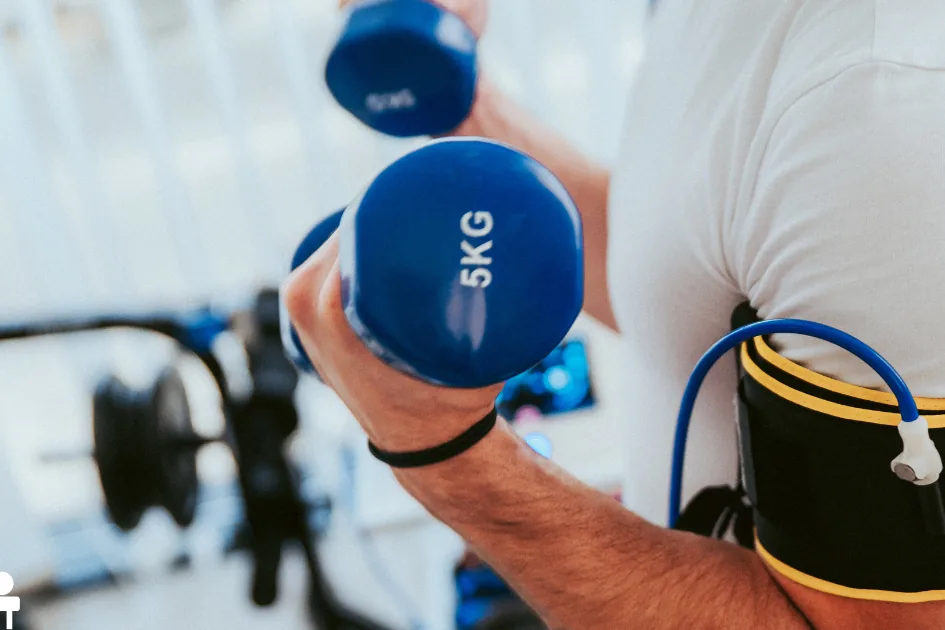
Then light exercise: light weights, structured high-repetition sets and short rests between them.
It burns considerably more than the weight suggests, and that burn is the mechanism rather than a side effect. It should not be sharp, and it should not involve numbness or pins and needles below the cuff. The cuff comes off between exercises.
What it does not do
It does not accelerate tissue healing. A graft heals on its own timeline and no amount of training changes that biology.
It does not replace range of motion work, swelling management or the neuromuscular re-education that early rehabilitation is built on.
And it does not permit you to skip stages. The protected period exists because something is healing; BFR works inside that period rather than shortening it.
Where else it is used
Well beyond post-operative work. An arthritic joint that flares under normal loading. A tendon that will not tolerate heavy work yet. Somebody in a boot who cannot load the ankle but can absolutely train the calf.
In healthy athletes it is used to add training volume without adding joint load, which matters in a congested season.
The common thread is the same in every case: a muscle that needs a stimulus attached to a structure that cannot take the usual one.
The wider uses are covered in build strength without heavy loads.
How progress gets measured
Thigh or arm circumference at a marked point, taken the same way each time. Strength testing when the joint tolerates it. And function — stairs, sit-to-stand, single-leg control — which is what the strength is for.
Those numbers are worth writing down at the start, because post-operative recovery is slow enough that week-to-week change is hard to feel.
If nothing is moving after a reasonable period, that is a reason to re-examine rather than to keep going. The most common cause is not the technique but the dose: too little volume, too long between sessions, or pressure set wrongly.
Talking to your surgeon about it
Keep it specific. Ask whether blood flow restriction training is permitted, from which week, at what percentage of limb occlusion pressure, and whether any particular movement is restricted.
That is a short conversation and it puts everybody on the same plan. It also avoids the common situation where a patient is doing something reasonable that their surgeon has simply never been told about.
If the answer is no, that is the answer, and there is still a great deal that can be done. The plan changes; it does not stop.
What people report while using it
A strong, deep burn during the set that is out of proportion to the weight. That is expected and it is the mechanism.
A heavy, fatigued feeling in the limb for several minutes afterwards, which settles. Some people feel light-headed on the first session, which is why it is introduced conservatively and why the first exposure is supervised.
What is not expected: sharp pain, numbness, pins and needles below the cuff, or any color change in the hand or foot. Those mean the cuff comes off and the pressure is reassessed rather than tolerated.
Delayed soreness the next day is common and usually milder than people expect given how the set felt at the time.
Starting before the operation
The strongest version of this is prehabilitation. Going into surgery with more quadriceps strength and better movement means coming out of it above a higher floor, and the evidence for that is considerably more settled than most things discussed in rehabilitation.
BFR has a place there too, particularly where the joint is already painful and will not tolerate conventional loading in the weeks before surgery.
If your operation is scheduled and you have a few weeks, that time is not dead time. It is the cheapest strength you will ever build, because you are not rebuilding it yet.
The first six weeks after surgery are covered in post-surgical rehab: the first six weeks. If getting to the clinic is hard early on, sessions can happen at home through mobile physical therapy (home visits carry an upcharge).
A realistic expectation
BFR is not magic and it is not a shortcut. What it removes is one specific obstacle: the impossibility of training a muscle attached to a joint that cannot yet be loaded.
The people who benefit most are those with the biggest gap between what the muscle needs and what the joint permits — early post-operative knees, painful arthritic joints, tendons in the irritable phase.
The people who benefit least are those who could simply lift heavier and have not been asked to. If a joint tolerates conventional loading, conventional loading is simpler, cheaper and at least as effective.
A practitioner reaching for a cuff before establishing which of those you are is reaching for equipment rather than reasoning.
Questions people ask
How soon after surgery can I start BFR?
That is your surgeon’s decision. Some protocols allow it within days, others after a number of weeks, and it starts only once the incision is healing, there is no infection and swelling allows a cuff.
Can BFR help after a knee replacement or ACL surgery?
Post-surgical rehab is one of the clearest uses for it, because it lets you train meaningfully during the weeks you would otherwise be losing muscle.
Is blood flow restriction safe after surgery?
Only after screening. A history of blood clots, certain vascular or cardiac conditions, uncontrolled blood pressure, infection, an open wound or lymphedema in the limb can rule it out.
How heavy are the weights with BFR?
Light, typically a small fraction of what conventional strength training would require. The joint is not asked to tolerate load it cannot handle.
Does BFR speed up healing after surgery?
No. A repair heals on its own timeline. BFR protects the muscle you will rebuild from, which shortens what follows.
Where can I get BFR after surgery in Dallas?
Dr. Brent Lockett, PT, DPT provides blood flow restriction therapy one-on-one at 10670 North Central Expressway, Suite 110, in North Dallas. Call (214) 600-7762.