The short answer
Frozen shoulder moves through three stages. Freezing, often two to nine months, is dominated by pain and night pain while range closes down. Frozen, often four to twelve months, hurts less but is very stiff. Thawing, often five to twenty-four months, is when range slowly returns. Gentle range and pain control suit the first stage; sustained stretching suits the second. In Dallas, Dr. Brent Lockett, PT, DPT identifies the stage first.
- Restricted passive external rotation is what identifies a frozen shoulder; without it, this is a different diagnosis.
- Freezing stage: pain control and gentle range. Frozen stage: sustained stretching and mobilization. They are not interchangeable.
- A corticosteroid injection has its best effect early, during the painful freezing stage.
- The full course runs one to three years, and measuring range every two weeks is more informative than tracking pain.
Adhesive capsulitis is one of the few musculoskeletal conditions with a genuinely predictable course, and one of the few where doing the wrong thing at the wrong time measurably prolongs it.
It is also frequently misdiagnosed at the start, when it looks like ordinary shoulder pain and nothing else.
What it actually is
The capsule surrounding the shoulder joint becomes inflamed and then thickens and contracts. The joint loses volume, and with it, range.
This is not a rotator cuff problem, not an impingement, and not something that responds to strengthening in the way most shoulder complaints do.
It is one of the reasons an accurate diagnosis matters here more than in most shoulder presentations: the plan is different in almost every respect.
The finding that identifies it
Loss of passive external rotation with the arm at the side. Someone else moves your arm, you do nothing, and the movement still stops early.
That is the key. In almost every other shoulder condition, passive range exceeds active range, because pain and weakness limit what you can do yourself while the joint itself still moves.
In a frozen shoulder the joint has genuinely lost capacity, so passive range is restricted too. External rotation goes first and most, followed by abduction and internal rotation.
The clinic’s frozen shoulder page covers how the examination confirms it.
Stage one: freezing
Two to nine months, typically. Pain dominates, and it is severe. Night pain is the hallmark and it is the reason people finally seek help.
Range is closing down but has not yet reached its worst, so patients and clinicians alike often blame something else — a cuff strain, a bursitis, a sleeping position.
This is the stage where aggressive stretching hurts. The capsule is inflamed and irritable, forcing it produces a flare, and a flare in this stage extends the whole course.
What helps: pain control, gentle range within comfort, activity modification, and a serious conversation with a physician about a corticosteroid injection, which is more effective in this stage than at any other point.
Sleeping setups for this stage are in why your shoulder hurts most at night.
Stage two: frozen
Four to twelve months. The pain eases substantially, particularly at night, which people take as recovery. It is not.
Stiffness is now the whole problem. Reaching a back pocket, fastening a bra, reaching a seatbelt, washing hair — all difficult or impossible.
This is the stage where sustained stretching and mobilization earn their keep. The capsule is no longer acutely inflamed, and it responds to being loaded into range and held there.
End-range mobilization, sustained holds, and consistent daily home work are the treatment. Progress is measured in degrees per month, not per session.
Stage three: thawing
Five to twenty-four months, and this is the part people find hardest to hear.
Range returns gradually. Most people regain most of it. A meaningful minority retain some permanent loss of external rotation, which is usually functionally irrelevant.
Strengthening belongs here, because a shoulder that has been guarded for a year has lost real muscle capacity, and returning range without returning strength leaves people feeling weak and vulnerable.
This is also where people stop coming, which is why so many end up with range back and confidence missing.
| Stage | Typical length | What dominates | What helps | What to avoid |
|---|---|---|---|---|
| Freezing | About 2 to 9 months | Severe pain, night pain, range closing down | Pain control, gentle range within comfort, a physician conversation about an injection | Aggressive stretching or forceful mobilization |
| Frozen | About 4 to 12 months | Stiffness, with pain easing | Sustained stretching, end-range mobilization, daily home work | Taking less pain for recovery and stopping |
| Thawing | About 5 to 24 months | Range slowly returning | Progressive strengthening of the whole shoulder girdle | Stopping when range is back but strength is not |
How to read this table: find your stage by what dominates, not by the calendar. Pain that wakes you points to freezing; stiffness with less pain points to frozen. The lengths vary widely between people. The last two columns are why the stage matters: the same stretch helps in one row and harms in another.
Total duration, honestly
One to three years for the full course, with two years being a fair average. Some resolve faster. Some are still limited at three.
Anyone promising to fix a frozen shoulder in six weeks is describing a different condition.
What treatment does change is how much range you keep, how much pain you go through, and whether you come out of it strong. Those are worth a great deal even if the timeline is largely fixed.

Who gets it
Most commonly between forty and sixty-five, and more often in women.
Diabetes is the single strongest association, and in people with diabetes the course tends to be longer and stiffer.
Thyroid disease is associated. So is a period of immobilization — after a fracture, after surgery, after any reason the arm stopped moving.
Some people develop it in the other shoulder later, particularly with diabetes. It rarely returns in the same shoulder.
Injections, and when they are worth it
An intra-articular corticosteroid injection during the freezing stage has the better evidence of anything available, particularly for the pain and particularly early.
Its effect on the final range is more modest, and the effect fades. But relief during the worst months, delivered at the point where night pain is destroying sleep, is worth having on its own terms.
Hydrodilatation — distending the capsule with fluid — is offered in some centers with reasonable results.
That decision belongs with a physician. My part is identifying the stage, saying plainly when an injection is likely to help, and making the referral.
Surgery, and when it comes up
Manipulation under anesthesia or arthroscopic capsular release are reserved for shoulders that have not moved after a properly conducted year, particularly in people with diabetes where the course tends to stall.
Both work reasonably well. Both are followed by an intensive rehabilitation period that is the actual determinant of the outcome.
Neither is a shortcut, and neither is a first-line option for a shoulder in stage one.
What the home program looks like
In the freezing stage: pendulum swings, supported range within comfort, and enough movement that the shoulder does not stiffen faster than the condition requires. Little and often, never into sharp pain.
In the frozen stage: sustained stretches held for thirty seconds to two minutes, several times a day, into a stretch that is uncomfortable but settles within minutes of stopping.
External rotation with a stick against a doorframe, flexion up a wall, and internal rotation with a towel behind the back are the three that matter.
In the thawing stage: the same, plus progressive loading of the whole shoulder girdle.
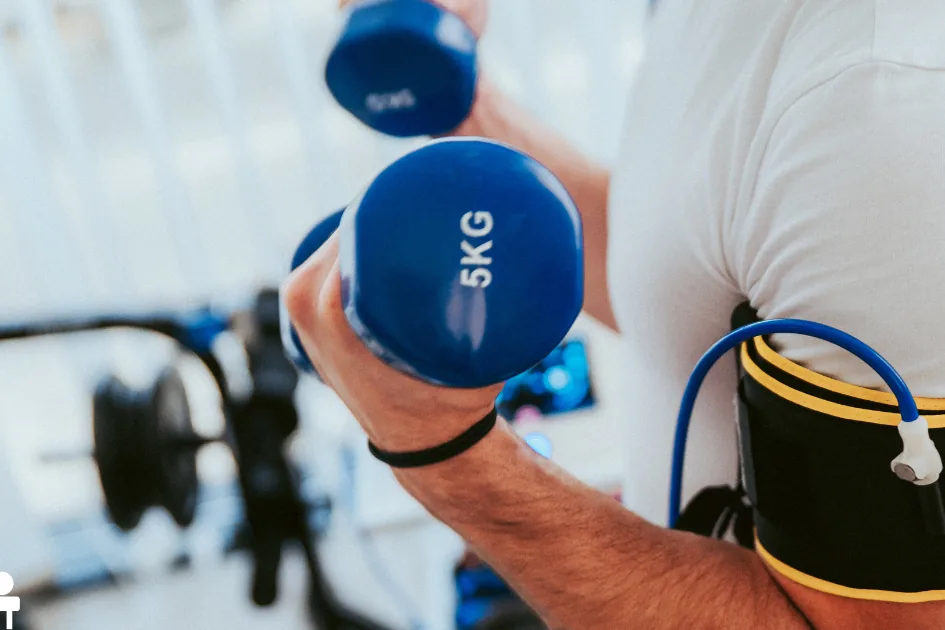
Where the arm cannot take heavy load, blood flow restriction therapy keeps it strong. Dr. Lockett treats frozen shoulders at 10670 North Central Expressway, Suite 110, in North Dallas, or at your home (home visits carry an upcharge).
How to tell whether you are making progress
Measure. Mark the height your hand reaches on a wall, or the point on your back your thumb reaches, and check it once two weeks.
Pain is a poor guide in this condition, because it improves on its own schedule regardless of what you do.
A shoulder that has gained nothing measurable in six weeks of consistent work needs the plan reviewed, and possibly a referral.
Living with it while it runs its course
Set the house up so the affected arm is not the one reaching. Move everyday items down from high shelves, keep a second pair of glasses downstairs, and put the kettle where you do not have to reach across for it.
Dressing gets easier if the affected arm goes into the sleeve first and comes out last. That single habit removes a large share of the daily aggravation.
Driving is manageable for most people, but reversing and reaching for a seatbelt are the two that catch you out. Reaching across with the other hand is a reasonable adaptation for a year.
None of that is giving in. Reducing the number of times a day the shoulder is provoked leaves it less irritable for the work that matters.
What to tell your employer or your family
That this has a known course, that it is measured in months rather than weeks, and that it will improve.
People around you will interpret slow progress as a lack of effort unless somebody explains the timeline. It is worth explaining once, clearly, rather than repeatedly apologizing for it.
For manual work, the practical accommodations are overhead tasks and repeated lifting above shoulder height. Almost everything else can continue.
And if the shoulder is your dominant side, expect the other one to take on more and to complain about it. That is worth mentioning at an appointment before it becomes a second problem.
What often gets diagnosed instead
Rotator cuff tendinopathy, which is far more common and does not restrict passive external rotation. If someone else can rotate your arm out normally, this is not a frozen shoulder.
Shoulder arthritis, which also restricts passive range and is distinguished on imaging and by history.
Referred pain from the neck, which produces shoulder pain without any restriction of shoulder range at all.
And, occasionally, something that needs a physician: an unexplained shoulder with systemic symptoms, night pain that is not positional, or a history of cancer is a referral rather than a treatment plan.
What I would want you to take away
Get the stage identified rather than guessed. It changes what you should do this week.
Do not let anyone stretch you hard in the freezing stage, however confident they are.
Do not stop when the pain goes, because the pain going is stage two beginning, not the condition ending.
And do the strength work at the end. It is the part that decides how the shoulder feels in the year after this is over.
Questions people ask
What are the three stages of frozen shoulder?
Freezing, where pain dominates and range is closing down; frozen, where pain eases but stiffness is marked; and thawing, where range slowly returns. Each stage needs a different approach.
How long does frozen shoulder last?
The full course commonly runs one to three years. Treatment matched to the stage does not fix the timeline, but it changes how much pain you go through and how much range and strength you keep.
Should I stretch a frozen shoulder?
Not hard in the freezing stage: forcing an inflamed capsule produces a flare and can prolong the condition. Sustained stretching belongs in the frozen and thawing stages, into discomfort that settles within minutes.
Is it frozen shoulder or a rotator cuff problem?
In a frozen shoulder the arm stops early even when someone else moves it, especially turning outward. A rotator cuff problem hurts and feels weak, but the arm can usually be moved passively.
Does a cortisone injection help frozen shoulder?
It has its best effect early, in the painful freezing stage, mainly for pain and sleep. It does not restore range on its own. That decision belongs with a physician.
Where can I get a frozen shoulder assessed in Dallas?
Dr. Brent Lockett, PT, DPT identifies the stage and treats frozen shoulders one-on-one at 10670 North Central Expressway, Suite 110, in North Dallas. Call (214) 600-7762.