The short answer
Jaw problems cause headaches mainly through two clenching muscles: the temporalis refers pain into the temple and behind the eye, and the masseter into the cheek, ear and teeth. The upper neck shares a relay in the brainstem with the nerve supplying the jaw, so the two are assessed and treated together. Resting your teeth apart is the first step. In Dallas, Dr. Brent Lockett, PT, DPT examines the jaw and neck in one visit.
- Temporalis and masseter refer pain into the temple, eye and teeth — the classic jaw-driven headache.
- The upper neck and the jaw share a relay in the brainstem, so they are assessed and treated together.
- Painless clicking is common and usually needs nothing; pain, restricted opening or locking does.
- A night guard protects teeth from grinding but does not stop the grinding, and resting teeth apart does more than any exercise.
The temporomandibular joint gets treated as a dental problem, and sometimes it is. Rather more often it is a muscular and postural problem that a dentist and a physical therapist should be looking at together.
What the joint does
The temporomandibular joint is one of the busiest joints in the body. It moves every time you talk, eat, swallow or yawn, which is a few thousand times a day.
It hinges and it slides, which is unusual, and a small disc sits between the surfaces to manage that combination.
Both sides work together whether you like it or not, so a problem on one side changes the mechanics on the other.
Where the headache comes from
Temporalis, the fan-shaped muscle over the temple, refers pain into the temple, behind the eye, and into the upper teeth. That referral pattern is the classic temple headache.
Masseter, the thick muscle at the angle of the jaw, refers into the cheek, the ear, the lower teeth and the jaw itself. Patients frequently arrive having already seen a dentist about a tooth that turns out to be healthy.
Both are clenching muscles. Both become tender and taut when clenching is habitual.
Needling these two muscles is covered in dry needling for headaches and TMJ.
Clenching, which most people deny
Daytime clenching is largely unconscious and enormously common under stress or concentration. People discover it when they are asked to notice, not before.
Night-time grinding is separate, more forceful, and often reported by a partner rather than the grinder. Waking with a tight jaw or a dull temple ache is the usual clue.
The resting position of the jaw should be teeth apart, lips together, tongue resting on the palate. Most people with jaw pain are resting with teeth in contact, which means the muscles never fully switch off.
Why the neck is always in the conversation
The trigeminal nerve supplies the jaw and face, and its relay in the brainstem receives input from the upper three cervical nerves as well. The two streams converge.
So an irritated upper cervical joint can produce facial and jaw symptoms, and jaw dysfunction can amplify neck-related headache. The traffic runs both ways.
Practically, this means an assessment that only examines the jaw is incomplete. In my experience the upper neck is involved in the clear majority of jaw cases, and treating it changes the jaw.

How neck-driven headaches behave is covered in migraine, tension or neck headache.
Clicking, and whether it matters
A jaw that clicks without pain and opens fully is extremely common and generally does not need treating. Population studies find clicking in a large minority of people with no complaint at all.
Clicking with pain, or with limited opening, or with a jaw that deviates markedly to one side as it opens, is a different matter and warrants assessment.
The concerning presentation is a jaw that locks — either unable to open past about twenty-five millimeters, or unable to close after opening wide. That needs seeing promptly.
How opening is measured
With a ruler, between the front teeth. Normal opening is roughly forty to fifty millimeters, or about three of your own fingers stacked vertically.
Under about thirty-five millimeters counts as restricted. Under twenty-five suggests the disc is obstructing rather than the muscles limiting.
Watching the path of opening matters as much as the distance. A jaw that swings off to one side and comes back is telling you which side is restricted.
| What you measure or see | What it usually means | What to do |
|---|---|---|
| About 40 to 50 mm, three fingers stacked | Normal opening | Nothing, if it does not hurt |
| Under about 35 mm | Restricted, usually by the jaw muscles | Assessment of the jaw muscles and upper neck; teeth-apart habit |
| Under about 25 mm | The disc may be blocking the joint | Prompt assessment, often shared with a dentist or oral surgeon |
| Jaw swings to one side as it opens | That side is restricted | Controlled opening toward a straight path |
| Clicks but opens fully without pain | Very common and usually harmless | No treatment needed |
How to read this table: measure between your top and bottom front teeth with a ruler, or stack your fingers, and find your row. Then watch the path in a mirror. A jaw that locks open or closed belongs with the third row and needs to be seen promptly, not stretched.
What treatment involves
Manual therapy to the jaw muscles, including work inside the mouth with a gloved hand for the medial and lateral pterygoids, which cannot be reached otherwise and are frequently the most tender structures present.
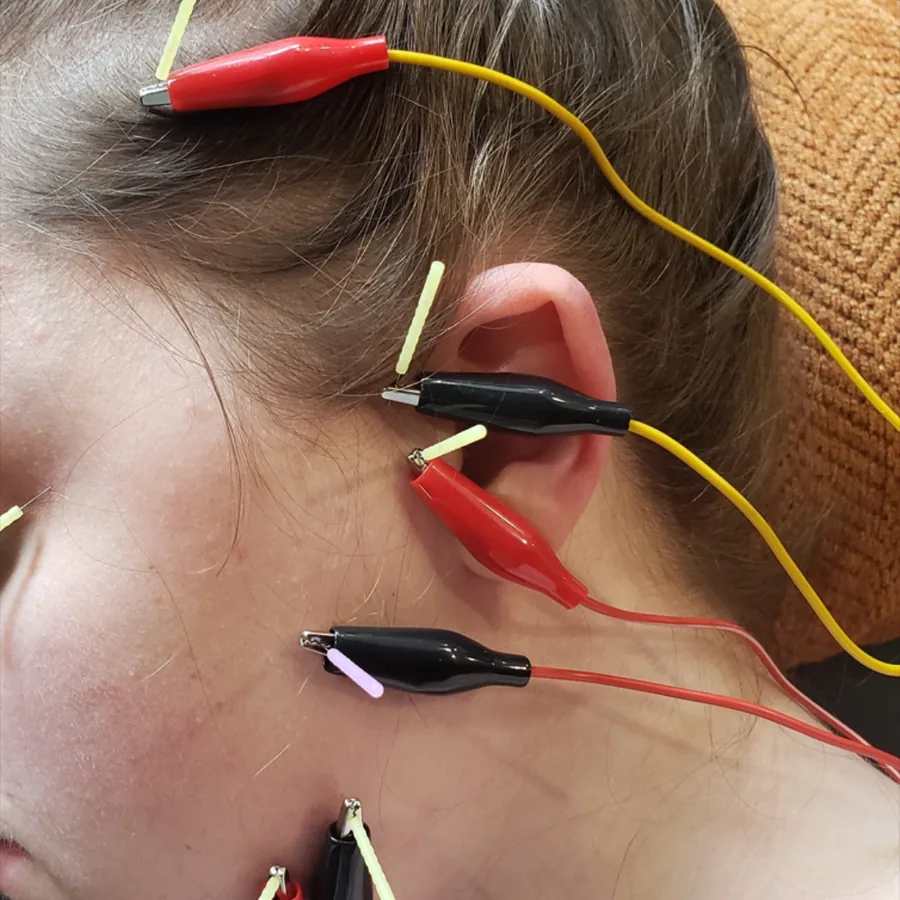
Dry needling into masseter and temporalis where they reproduce the familiar headache. This is often the fastest single change, and it is uncomfortable for about ten seconds.
Upper cervical mobilization or manipulation, because of the convergence already described.
Then motor control work: controlled opening without deviation, tongue position, and the deep neck flexor work that supports the whole arrangement.
What you do between sessions
Teeth apart. That single instruction, applied a hundred times a day, does more than any exercise. Most people need a reminder system for the first two weeks — a sticker on the monitor works as well as anything.
Soft diet during a flare. Not forever, but chewing steak and bagels through an irritable joint prolongs things.
Avoid gum entirely while symptomatic. Avoid opening wide — support the chin when you yawn.
Heat over the masseter and temporalis for ten minutes in the evening, which is unglamorous and effective.
The dentist's part
A night guard protects the teeth from grinding, which is worth having if you grind, and it does not stop the grinding. That distinction matters and it is often lost.
Bite issues genuinely exist and occasionally drive the problem. They are less often the cause than the historical dental literature suggested, and irreversible bite alteration is not a first-line treatment for jaw pain.
Where a tooth problem is possible — pain on biting a specific tooth, sensitivity to hot or cold, swelling — that goes to a dentist first. Muscle referral mimics toothache convincingly, but so does an actual infected tooth.
What a first jaw appointment involves
Measuring opening with a ruler, watching the path of the jaw as it opens and closes, and testing how it moves side to side. All of that takes about five minutes and gives numbers worth re-testing later.
Palpating temporalis, masseter and the accessible part of the pterygoids to see which of them reproduces your familiar headache. Reproduction is the finding that matters, not tenderness on its own.
Screening the upper cervical spine, including the flexion-rotation test, because the two regions are so consistently linked.
Then a conversation about clenching, sleep and what your day actually looks like, which is where most of the useful information turns up.
Exercises that are worth doing
Controlled opening: tongue resting on the palate, open slowly to the point where the jaw wants to deviate, and stop there. Ten repetitions, several times a day. The aim is a straight path, not a big range.
Resisted opening and closing with light pressure from two fingers, holding a few seconds each way, to give the muscles something to do other than clench.
Deep neck flexor work, for the reasons already covered.
What is not worth doing is aggressive jaw stretching. Forcing a restricted jaw open reliably makes it more irritable, and people arrive having spent a month proving that.
Where stress fits
Directly and mechanically. Clenching is a stress behavior, clenching loads the jaw muscles continuously, and continuously loaded muscles become painful. There is nothing mysterious about the chain.
Sleep quality affects both grinding and pain sensitivity, so it is worth addressing rather than mentioning in passing.
None of that makes the pain psychological. The muscles are genuinely working and genuinely sore.
A realistic course
Most straightforward muscular jaw pain improves noticeably within three or four sessions, with home work doing much of the lifting.
Longer-standing cases with restricted opening take longer, and the marker to watch is millimeters of opening rather than pain score, because it improves first.
Cases with true disc displacement and locking are shared care — worth treating, worth a dental or oral surgical opinion alongside.
The clinic’s headaches and migraines and neck pain pages cover the examination. Dr. Lockett sees jaw and headache patients at 10670 North Central Expressway, Suite 110, in North Dallas.
Sleep, and the jaw at night
Side sleeping with a hand or forearm under the jaw applies hours of sideways pressure to a joint that is already irritable. It is one of the more common aggravators and one of the easiest to change.
Back sleeping avoids it entirely, which is easy to recommend and hard to adopt. A pillow arrangement that discourages rolling onto the sore side is the practical compromise.
If you wake with the jaw tight and the temples aching most mornings, that pattern points to night-time grinding and belongs in a conversation with your dentist as well as here.
When it is not the jaw
Facial pain in sharp electric bursts triggered by light touch or a breeze suggests trigeminal neuralgia, which is a neurological diagnosis and needs a physician.
Persistent ear pain, hearing change or discharge belongs with a physician too, even though jaw referral into the ear is common.
New jaw pain on chewing in someone over fifty, with headache and scalp tenderness, raises giant cell arteritis and is urgent.
And jaw or facial discomfort brought on by exertion, particularly with chest symptoms or breathlessness, is a cardiac question. That is emergency services, immediately.
Questions people ask
Can TMJ cause headaches?
Yes. The temporalis and masseter, the main clenching muscles, refer pain into the temple, behind the eye, the cheek and the teeth. That pattern is the classic jaw-driven headache.
Should I worry if my jaw clicks?
Not if it opens fully and does not hurt; painless clicking is very common. Clicking with pain, limited opening, a jaw that swings to one side or a jaw that locks needs assessment.
How wide should my jaw open?
About forty to fifty millimeters between the front teeth, roughly three of your own fingers stacked. Under about thirty-five is restricted, and under twenty-five suggests the disc is blocking the joint.
Does a night guard stop teeth grinding?
No. A night guard protects the teeth from grinding but does not stop it. It is worth having if you grind, alongside the work on the jaw muscles and the neck.
What is the right resting position for the jaw?
Teeth apart, lips together, tongue resting on the roof of the mouth. Most people with jaw pain rest with their teeth touching, so the clenching muscles never fully switch off.
Where can I get jaw pain and headaches assessed in Dallas?
Dr. Brent Lockett, PT, DPT examines the jaw and the upper neck one-on-one at 10670 North Central Expressway, Suite 110, in North Dallas. Call (214) 600-7762.