The short answer
Most clients are encouraged to come to the North Dallas clinic, where the equipment for loading and testing is in one place. Mobile visits across Dallas are an option at an upcharge, and they earn their place when the problem is tied to a specific environment, when travel is the obstacle, or early after surgery.
- The North Dallas clinic is the default, because loading and testing both need equipment that does not travel.
- Mobile visits earn their place when the problem is tied to an environment, early after surgery, or when travel is the obstacle.
- The assessment, the hands-on work and the hour are identical either way — only the available load and space differ.
- Plenty of plans use both, and switching partway through is a scheduling conversation rather than a clinical one.
This gets asked before almost every first booking, and the honest answer is that the clinic is the default and the visit is the exception that sometimes matters a great deal.
Here is how I decide, and how you can.
Why the clinic is the default
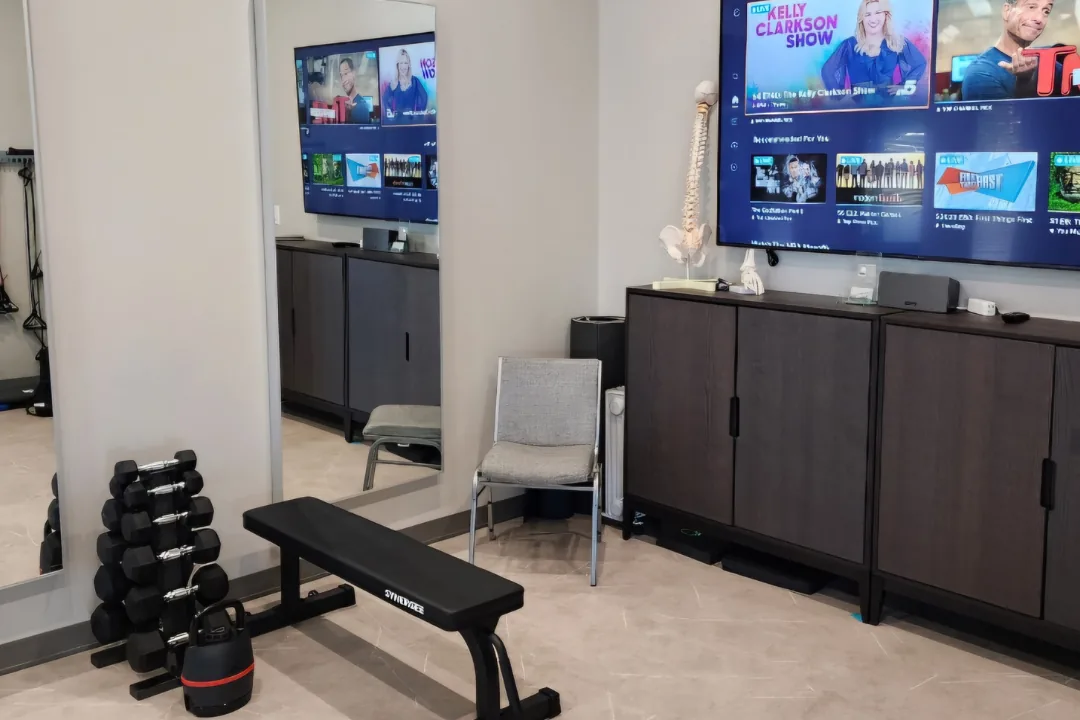
Everything needed to load and test you is in one room: weight, cable resistance, a treatment table at the right height, blood flow restriction equipment, and the space to run, hop and land.
Loading is what makes a result hold, and loading needs resistance that keeps going up. A program capped by what fits in a car is a program with a ceiling on it.
Testing matters as much. Strength measured the same way, in the same position, on the same equipment, is what turns progress from an impression into a comparison.
So for most problems, most of the time, the clinic is where the work is done properly.
When a visit is genuinely the better call
When the problem is tied to a specific environment. A desk producing neck pain, a workshop, a home gym with the bench at the wrong height, a set of stairs someone has been avoiding for six weeks.
People often describe their setup inaccurately, not through any fault of their own but because you stop noticing an arrangement you use daily. Seeing it removes the guesswork.
Early after surgery, when traveling is the hardest part of the week and the work is range, swelling management and getting a muscle to fire — none of which needs equipment.
And when travel is the actual obstacle. A course of treatment that stops after three sessions because the drive was impossible has not helped anybody.
What does not change between them
The assessment, the hands-on work, the loading and the measurements. Manipulation, dry needling and cupping all travel.
The session is a full hour, one to one, with the same therapist either way.
You leave with the same kind of plan and the same home program, and the same numbers get re-tested at the same points.
Only the address is different, and the equipment available in it.
What does change
Load. There is a practical ceiling on what can be carried in, and heavier strengthening eventually needs a rack, a machine or a heavier set of weights.
Space. Return-to-running work, jumping, cutting and change-of-direction testing need room that most homes do not have.
Some testing. Certain measurements are more reliable on fixed equipment, and comparing a number taken at home in March with one taken in the clinic in May is comparing two different things.
So a plan that starts at home usually moves in as the work turns to loading, which is a normal progression rather than a change of mind.
| Situation | Better room | Why |
|---|---|---|
| Heavy strengthening later in a plan | Clinic | The load has to keep going up, and heavier weights do not travel |
| Running, jumping and return-to-sport tests | Clinic | They need space and the same equipment each time |
| Neck pain tied to one desk or workstation | One visit at the office, then the clinic | Ten minutes with the real furniture beats a description |
| The first weeks after surgery, when you cannot drive | Home | The work is range, swelling and muscle activation, and none of it needs equipment |
| Travel is why earlier treatment stopped | Home or office | A plan you can attend beats a better plan you cannot |
| Progressing a program or checking technique | Video | It is watching and talking, not hands-on work |
How to read this table: start in the clinic unless one of the middle rows describes you, and expect a plan that starts at home to move in once the loading gets heavy. Home visits carry an upcharge, so the table is also a guide to when the extra cost buys something. Details are on the mobile physical therapy and telehealth physical therapy pages.
A common pattern that works well
Discovery visit by video or phone, because it is a conversation.
First full assessment in the clinic, so the baseline measurements are taken on the equipment they will be re-tested on.
One visit to the place that matters — the desk, the home gym, the workshop — if the problem is bound up with an environment.
Then the rest of the plan in the clinic, where the loading can keep progressing.
The desk case, specifically
Neck and upper back pain in office workers is the clearest example of a problem worth seeing in place.
Screen height, monitor position, forearm support and chair height interact, and adjusting them properly takes ten minutes with the actual furniture and a great deal longer over a description.
A second monitor used for hours off to one side is the most common cause of a one-sided neck complaint I see, and it is usually invisible in a clinic conversation.
One visit is normally enough to sort it. After that the strength work, which is the part that changes how a long day feels, happens wherever is convenient.
The four changes that matter most are in a desk setup that reduces neck pain.
The post-operative case
The first weeks after surgery decide a great deal, and the work in that period is range, swelling control and getting the muscle to switch on.
None of that needs equipment, and all of it needs to happen on time rather than whenever transport can be arranged.
Getting the home set up matters too: a firm chair with arms, a clear route to the bathroom, everything at waist height. Those are easier to fix in the house than to describe in a clinic.
Then, as loading begins around week six, the sessions move in.

What those first weeks contain is on the post-surgical rehabilitation page.
What it does not mean
It does not mean mobile care is a lesser version of the same thing. Within what it can do, the session is identical.
It does not mean the choice is permanent. Plenty of people use both across a single plan, and switching is a scheduling conversation.
And it does not mean the clinic is inconvenient. It is in North Dallas, on North Central Expressway, and every visit there is one-on-one with the same clinician.
The point is simply that the room should be chosen for the problem rather than out of habit.
The practical considerations
Space: enough clear floor to lie down and to move through a few exercises. A living room is usually plenty.
Privacy, if the session includes needling or cupping. An office with a glass wall is worth thinking about in advance.
Time: appointments are scheduled with travel accounted for, so the hour you book is an hour of treatment.
Area: home and office visits run across Dallas, including Park Cities, Preston Hollow, University Park and Highland Park. Anything further is a conversation rather than a refusal.
Where telehealth fits between the two
Better than people expect for progressing a program, reviewing technique, and planning a return to activity, all of which are watching and talking rather than hands-on work.
Useful for the follow-up visits in a plan whose early sessions were in person.
Not a substitute where manual therapy, needling or manipulation is the reason you are coming.
A mixed plan suits a lot of people: in person where hands are needed, video where they are not, and considerably less time spent traveling either way.
What a first visit at home actually looks like
The same hour as a clinic session, and it starts the same way: history, then testing what moves, what hurts and what is weak.
A treatment table comes in for the hands-on portion, so manipulation, needling and cupping happen on a proper surface rather than on a sofa.
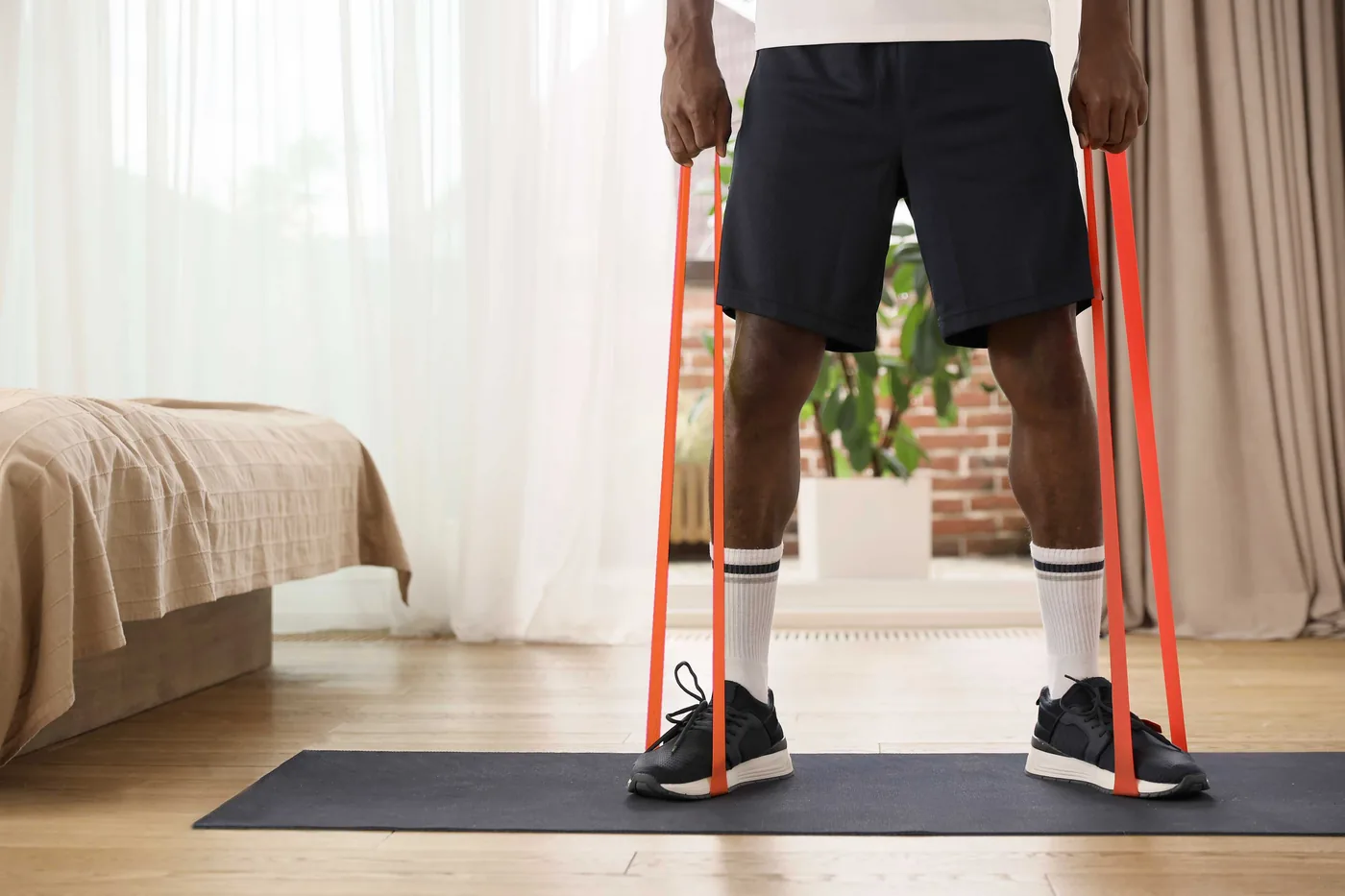
Then the loading, using bands, weights and whatever is already in the house, and the home program is written around the equipment you actually own rather than the equipment a printout assumes.
And the environment gets looked at while I am there, which is the part that changes advice most often and is impossible to do remotely.
What it costs, and what it does not
A visit at your home costs more than a clinic visit: the booking form on this site lists it as more convenience, with an upcharge. Call (214) 600-7762 for the current price.
The practice is out of network either way, with a superbill after every session for any out-of-network reimbursement.
What a visit can cost you is progression, if the plan stays at home past the point where it needs a rack and a heavier set of weights. That is worth naming at the start rather than discovering at week eight.
So the honest framing is that mobile visits buy convenience and context, and the clinic buys load and space. Most plans want some of each, in that order.
How to decide before you book
Is the problem tied to a room, a chair, a bench or a bed? If yes, one visit there is worth a great deal.
Is travel the reason previous courses of treatment stopped early? If yes, remove the obstacle.
Is the plan going to need heavy loading and space? If yes, expect to be in the clinic for that phase.
If none of those apply, book the clinic. It is the default for a reason.
What to ask at the discovery visit
Which room suits my problem, and why?
What would we do in the clinic that we could not do at my house?
At what point in the plan would that start to matter?
Those three questions settle it in about two minutes, and the answer is allowed to change once the assessment has actually happened.
What happens in that first conversation is described in what happens at a discovery visit.
Questions people ask
Does mobile physical therapy cost more than a clinic visit?
Yes. A visit at your home carries an upcharge over a clinic visit. Call (214) 600-7762 for the current price. The practice is out of network either way, with a superbill after every session.
Is a home visit the same treatment as a clinic visit?
Within what it can do, yes: the same hour, one-on-one, with the same clinician, and manipulation, dry needling and cupping all travel. What changes is how much load and space are available.
When is the clinic better than a home visit?
When the plan needs heavier strengthening, running or jumping, or testing on the same equipment each time. Most plans move into the clinic once the loading gets heavy.
Can a plan mix home, clinic and video visits?
Yes. Plenty of plans use more than one, and switching is a scheduling conversation rather than a clinical one.
Which areas do home visits cover?
Dallas and the surrounding areas, including Park Cities, Preston Hollow, University Park and Highland Park. Tell us your location and you will get a straight answer.