The short answer
Hip pain at night that is worst lying on your side is usually gluteal tendinopathy, not bursitis. The gluteal tendons are pressed against the bone by side lying and crossed-leg positions. A thick pillow between the knees often eases the nights within one to two weeks, and twelve weeks of progressive hip loading changes the problem. In Dallas, Dr. Brent Lockett, PT, DPT treats it one-on-one.
- Lateral hip pain worse lying on that side is usually gluteal tendinopathy, not bursitis.
- The mechanism is compression from hip adduction, so crossed legs, hanging on one hip, and figure-four stretches all make it worse.
- A thick pillow between the knees resolves the night symptoms for many people within two weeks.
- Twelve weeks of progressive abduction loading is what changes the underlying problem.
It is called trochanteric bursitis on a great many referral letters, and the bursa is rarely the main event.
What matters practically is that the two explanations lead to different treatment, and the more common one responds well to something you can start this week.
Where the pain is
On the outside of the hip, over the bony point you can feel when you press about a hand's width below your waist.
It often spreads down the outside of the thigh, sometimes to the knee, and it rarely goes below it.
Lying on that side is the classic aggravator. Lying on the other side with the top leg falling across the body is the second, and it catches people out because they believe they are avoiding the problem.
Standing on one leg, climbing stairs, and getting out of a low car are the daytime triggers.
Why it is a tendon and not a bursa
Imaging studies of this presentation consistently find tendon changes in the gluteus medius and minimus. Bursal inflammation, when it is present, is usually secondary.
The mechanism is compression. When the hip adducts — the knee drifting toward the midline — the iliotibial band presses the tendons against the bone underneath.
That compression, repeated or sustained, is what irritates the tendon. It is why the positions that hurt are all adduction positions.
The label matters because bursitis implies inflammation and injections; tendinopathy implies compression management and loading. The second works better.
Who gets it
Women considerably more than men, and most often between forty and sixty.
Runners and walkers who have recently increased volume, particularly on cambered roads or with a narrow gait.
People who have been inactive and then done something demanding, and people after a period on crutches or with a limp from another problem.
It is one of the most common causes of lateral hip pain in the general population and it is under-recognized in every one of those groups.
The positions to stop doing
Standing with the weight on one leg and the hip pushed out sideways. This is the single most common daytime compression position and most people do it without noticing.
Sitting with legs crossed, or with knees together and feet apart.
Sleeping on the affected side, obviously. Also sleeping on the good side without a pillow between the knees, because the top leg falls into adduction and compresses the tendon on the upper side.
Stretching the outside of the hip, particularly the figure-four and the cross-body knee pull. Those positions compress the exact tendon that is irritated, which is why the stretch that feels productive is the one making it worse.
| Position | Why it hurts | Instead |
|---|---|---|
| Lying on the painful side | Body weight presses the tendon on the bone | Lie on the other side or on your back |
| Lying on the good side, top knee dropped | The top leg falls inward and compresses the upper hip | A thick pillow between the knees and ankles |
| Standing with the hip pushed out sideways | The most common daytime compression position | Weight on both feet |
| Sitting cross-legged, or knees together and feet apart | Holds the hip in adduction | Knees apart, feet under the knees |
| Low, soft seats and bucket car seats | Deep bend plus adduction for long stretches | Raise the seat; get up every half hour |
| Figure-four and cross-body hip stretches | Press the irritated tendon against the bone | Stop them; use isometric abduction instead |
How to read this table: every row in the first column is the same movement, the knee drifting toward the midline. Changing these positions is free and works before any exercise has had time to, which is why it comes first.
The sleeping setup
On the unaffected side, with a firm pillow between the knees and ankles so the top leg stays level with the hip rather than dropping.
A thin pillow is not enough. The knees need to be roughly hip-width apart, which usually means a full-length body pillow or two stacked ordinary ones.
On the back, with a pillow under the knees, is comfortable for most people and is worth trying if side lying stays painful.
Give it a week. This change alone resolves the night symptoms for a good proportion of people, and it does so before any exercise has had time to work.

The loading program
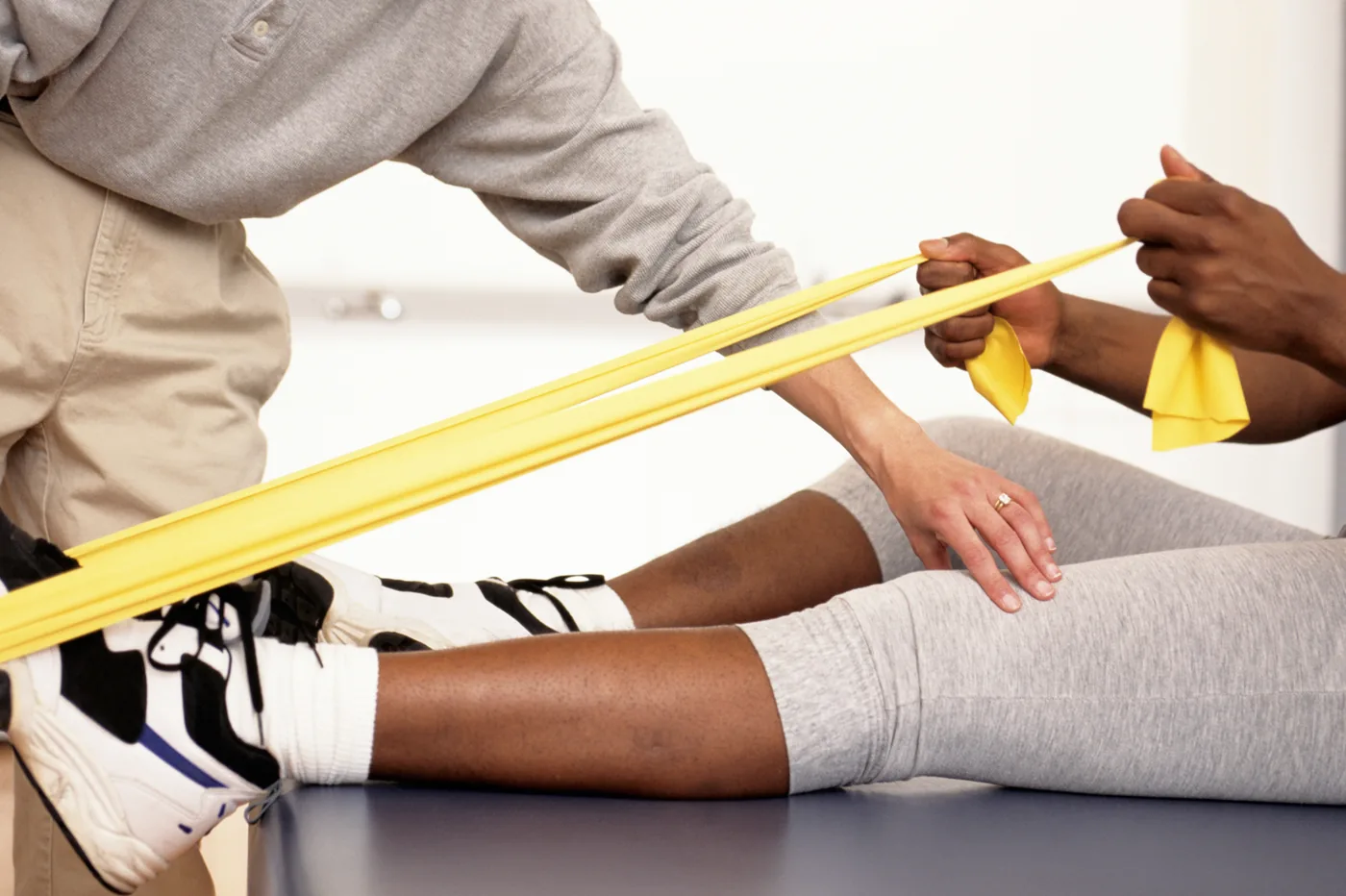
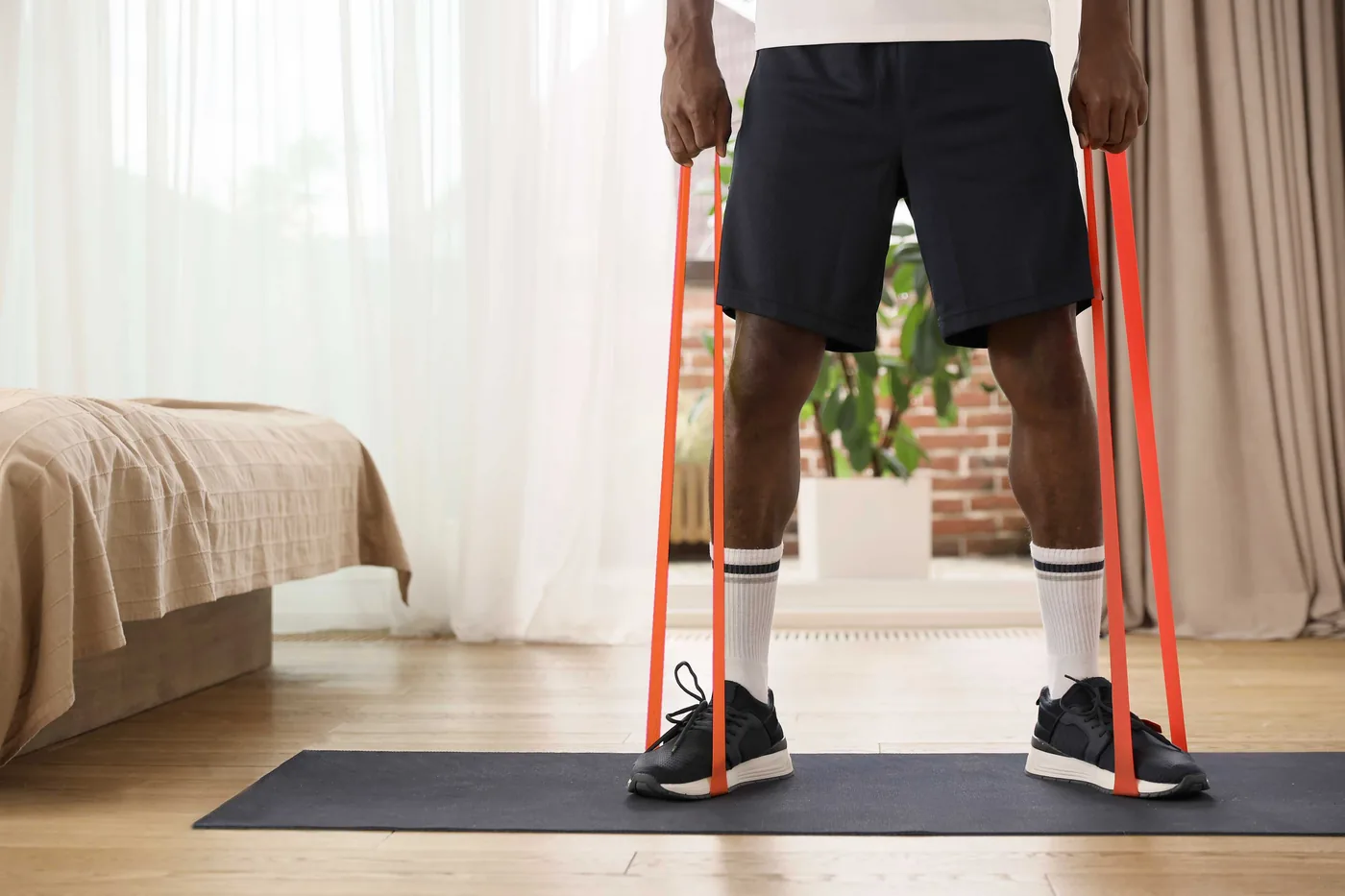
Isometric hip abduction first: lying on your back or standing, pressing outward against a band or a wall, holding thirty to forty-five seconds, five times. Comfortable, and often immediately pain-relieving.
Then progressive abduction strengthening — side-lying leg raises with the top leg slightly behind the body, banded walks, and single-leg work as tolerance improves.
Then loaded single-leg tasks: step-ups, split squats, and eventually the specific demand you have, whether that is running or carrying a grandchild upstairs.
Three sessions a week, twelve weeks. The trials on this condition that show good outcomes used education plus exercise, and education means the compression positions above.
What the evidence says about injections
Corticosteroid injection into the bursa produces good short-term relief, and at one year the exercise group does better.
That pattern will be familiar from every other tendon on this site, and the explanation is the same: relief without capacity is temporary.
Injections have a place where pain is preventing any loading at all. As a standalone treatment they are a way of postponing the work.
Shockwave therapy has some supportive evidence for recalcitrant cases and is reasonable to consider after loading has been genuinely tried.
When it is not the tendon
Hip joint pathology — osteoarthritis, labral tears — usually produces groin pain rather than lateral pain, and restricted hip rotation on examination.
Referred pain from the lumbar spine can present laterally, and the clue is that hip tests are unremarkable while back movements reproduce it.
Meralgia paresthetica gives numbness and burning on the outside of the thigh rather than tenderness over the bone.
And a small number of lateral hip presentations are something else entirely: unexplained night pain that is not positional, in someone with a history of cancer, weight loss or fever, is a physician's question first.

Why the label so often says bursitis is covered in bursitis is rarely just bursitis.
Why the standard advice fails
Because the standard advice is rest, ice and stretching, and all three are wrong here.
Rest reduces the tendon capacity that is already the problem. Ice does nothing durable for a non-inflammatory tendon. Stretching compresses the irritated tissue.
That combination is why so many people arrive having done everything they were told for six months with no change at all.
Reversing all three — load it, stop stretching it, decompress the sleeping and standing positions — usually produces movement within a month.
How long it takes
Night symptoms often improve in one to two weeks with positioning alone.
Daytime symptoms follow the loading program: noticeable change at four to six weeks, substantial change at twelve.
Longstanding cases of a year or more take longer, and are still worth doing, because the alternative is another year of the same.
The measure worth tracking is how long you can lie on the affected side and how many times you wake, rather than a pain score.
Running, walking and the gait question
A narrow gait — feet landing close to a single line — increases hip adduction and therefore compression. Widening the stance slightly is one of the few gait changes with a clear rationale here.
Cambered roads load the downhill leg into adduction. Alternate the direction of your route, or find flat ground while it settles.
Increasing cadence slightly reduces the load per step and is easier to sustain than a conscious change in foot placement.
None of that replaces the strengthening. It reduces the daily provocation while the strengthening works.
Why the stretch feels good and makes it worse
Stretching an irritated tendon produces a brief change in symptoms through the nervous system, which is why the figure-four feels productive at the time.
Mechanically, that same position drives the tendon harder against the bone. The relief lasts twenty minutes and the compression lasts as long as you hold it.
So the pattern is a person stretching four times a day for months, feeling briefly better each time, and getting steadily worse.
This is the single most common self-treatment error in lateral hip pain, and stopping it is usually worth more than anything added in its place.
What a first appointment establishes
Whether the pain is reproduced by palpating over the greater trochanter and by single-leg standing, which together make the diagnosis in most cases.
Hip abduction strength, measured and compared side to side, because that number is the target and the progress marker.
Whether the lumbar spine or the hip joint is contributing, which changes the plan.
And the details of how you sleep, sit and stand, which is where most of the daily compression is happening and where the fastest wins are.
More is on the clinic’s hip pain page. When loading hurts, blood flow restriction therapy builds the gluteal muscles at light loads. Dr. Lockett treats it at 10670 North Central Expressway, Suite 110, in North Dallas, or at your home (home visits carry an upcharge).
Sitting, which nobody thinks about
Low, soft seats put the hip into deep flexion and adduction at the same time, which is the compression position held for an hour at a stretch.
Car seats are frequently the worst offender, particularly bucket seats, and a long commute is a long sustained compression.
Raising the seat, sitting with the knees apart rather than together, and getting up every half hour all reduce the daily dose.
None of that is complicated. It is simply the daytime equivalent of the pillow between the knees, and it matters roughly as much.
What to start tonight
Pillow between the knees, thick enough that the top knee stays level with the hip.
Stop the figure-four stretch and any cross-body hip stretch entirely.
Stand with weight on both feet. Notice how often you do not, which for most people is a surprise.
Add isometric abduction: stand in a doorway, press the outside of the affected leg into the frame, hold forty seconds, five times, twice a day.
Questions people ask
Why does my hip hurt at night when I lie on my side?
Usually because lying on that side, or on the other side with the top knee dropped, presses the gluteal tendons against the bone. This is gluteal tendinopathy, which is often labeled bursitis.
How should I sleep with hip pain?
On the other side with a thick pillow between the knees and ankles, so the top knee stays level with the hip, or on your back with a pillow under the knees.
Is hip pain at night bursitis?
Usually not on its own. Imaging of this presentation consistently finds gluteal tendon changes; bursal irritation, when present, is mostly secondary.
Should I stretch a painful outer hip?
No. Figure-four and cross-body stretches press the irritated tendon against the bone. They feel good briefly and keep the problem going.
How long does gluteal tendinopathy take to get better?
Night symptoms often improve within one to two weeks with positioning. The loading program brings noticeable change at four to six weeks and substantial change at about twelve.
Where can I get hip pain at night treated in Dallas?
Dr. Brent Lockett, PT, DPT treats lateral hip pain one-on-one at 10670 North Central Expressway, Suite 110, in North Dallas. Call (214) 600-7762.