The short answer
After dry needling, expect a deep, dull soreness like the day after an unfamiliar workout, usually worst that evening or the next morning and gone within 24 to 48 hours. An occasional small bruise is minor and settles within a few days. Keep moving, leave heavy loading of the treated muscle until the next day, and call if pain is still building on day three. Dr. Brent Lockett, PT, DPT needles in Dallas.
- Deep, achy soreness for 24 to 48 hours is expected; sharp or spreading pain is not.
- Small bruises are occasional, cosmetic, and unrelated to how well it worked.
- Move the area afterwards — loading inside the window is what makes the change hold.
- Call if pain is still building on day three, or if numbness or spreading redness appears.
Most of what people worry about after dry needling is completely ordinary, and most of what actually matters gets no mention at all. This is the version I give patients on the table, written down so you have it later.
The soreness, and why it happens
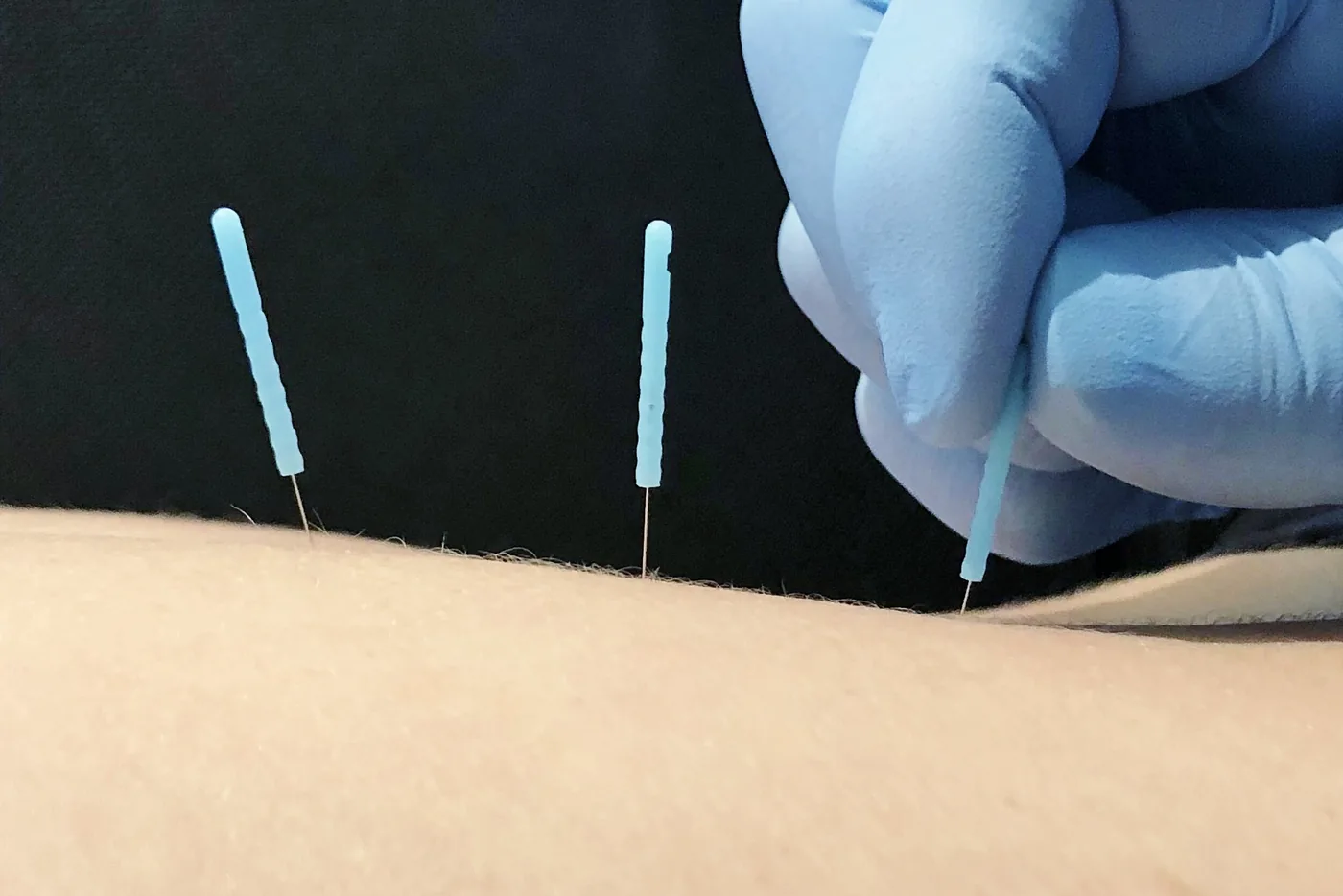
A needle passed into a taut band produces a small, controlled irritation. The muscle responds the way muscle responds to any unfamiliar work: with a dull, deep ache that builds over a few hours.
It is usually worst somewhere between the evening of the treatment and the following morning, and it is usually gone inside 48 hours. Some areas — the gluteals, the calf, the forearm — hold on longer than others.
The quality matters more than the intensity. Ordinary post-needling soreness is achy and diffuse, like the day after a heavy session in the gym. Sharp, electrical or spreading pain is a different thing and does not belong here.

What the needle itself feels like is covered in does dry needling hurt?.
Marks and bruises
Small bruises happen occasionally, particularly over the shoulders, the forearm and anywhere the tissue is thin. They come from a tiny vessel being nicked, which is unavoidable when a needle passes through tissue that contains vessels.
They are minor and cosmetic, they settle within a few days, and they say nothing about how well the treatment worked.
People on blood thinners bruise more, which is worth saying before the first session rather than discovering afterwards. It rarely changes whether we needle; it often changes where.
What to do in the first 48 hours
Move. This is the single most useful thing and the one people most often skip. A muscle that has just been released needs to be used through its new range, or it reverts to the length it knew.
That is why loading follows needling in the same session here. What you do at home afterwards is a continuation of that, not an optional extra.
Ordinary activity is fine. Walking is good. Heat generally feels better than ice on post-needling soreness, though neither changes the outcome much — use whichever makes you more likely to keep moving.

What to avoid, and why
Hard training on the treated area the same day is worth skipping. Not because it is dangerous, but because it makes it impossible to tell what caused what: if you are sore on Tuesday, was that the needling or the session you did afterwards?
Deep tissue massage on the same area on the same day is the same problem, plus unnecessary irritation of tissue that has already had enough input.
Alcohol in quantity and a very hot sauna are both worth avoiding for a few hours, mostly because they make light-headedness more likely in the small number of people prone to it.
How to tell it worked
Not by how sore you are. Soreness measures how much input the tissue received, not how much the problem changed, and a punishing session is not a better one.
The marker is what the area can do. Range that was not there before. A movement that used to catch and does not. Load tolerated with less protest the next day.
That is why a marker gets tested before and after, in front of you. Turn your head and see where it stops; get needled; turn it again. That comparison is worth more than any description I could give you.
When to call
Pain that is still building on day three, rather than fading. Numbness or tingling that has not resolved. Spreading redness, heat or swelling around a needle site. Any fever.
Those are uncommon, and almost all of them turn out to be nothing. They are still worth a call rather than a wait, because the cheap version of that conversation is a phone call and the expensive version is a week of guessing.
Any difficulty breathing after needling around the chest wall or upper back is a different category entirely and means urgent medical attention, not a call to me. It is rare, and you should know what it looks like anyway.
| What you notice | Normal? | What to do |
|---|---|---|
| Dull, achy soreness in the treated area for 24 to 48 hours | Yes | Keep moving; light activity helps it settle |
| Feeling loose and slightly tired for a few hours | Yes | An easy day; heavy loading of that muscle can wait until tomorrow |
| A small bruise at a needle site | Yes, occasionally | Nothing; it settles within a few days |
| Pain still building on day three | No | Call the clinic |
| Numbness that has not resolved, spreading redness, heat, swelling or fever | No | Call the clinic |
| Any difficulty breathing after needling around the chest wall or upper back | No, and rare | Seek urgent medical care straight away |
How to read this table: the first three rows are the ordinary aftermath and need nothing but movement. The rest are uncommon, and each one is worth a call rather than a wait; the last one is an emergency.
Why the area sometimes feels worse before better
A muscle that has been guarding for months is holding a position it considers safe. Releasing that tension asks the surrounding tissue to work in a range it has not used, and unfamiliar work produces soreness.
So there is a window — usually the first day — where the treated area feels looser but the region around it feels busier. That is the rest of the system taking up work it had delegated.
It settles as the new range becomes normal, which is another argument for using it rather than protecting it. The people who report the longest soreness are almost always the ones who spent the next day being careful.
If it has not settled by the third day, that is the point to say so rather than to assume it is part of the process.
What to tell me at the next visit
Three things, and they take thirty seconds. How sore, for how long, and what changed. Not just whether it hurt — whether the movement you could not do became easier, and for how long it stayed easier.
That last number is the useful one. Relief lasting six hours and relief lasting four days call for completely different next steps, and I cannot tell which happened unless you noticed.
Also mention anything that surprised you. Light-headedness, an unusual referral pattern, soreness somewhere you did not expect. None of those are necessarily problems, and all of them are information.
How this fits the rest of the plan
Needling opens a window. It reduces tension in a band that has been referring pain, and that reduction lasts somewhere between hours and days depending on how long the problem has been there.
What decides whether the change holds is what happens inside that window. Loading the muscle through the range you just got back is what teaches the nervous system that the range is safe to keep.
Which is why a plan built on needling alone tends to need repeating forever, and a plan built on needling plus loading tends to end. If somebody is offering you the first kind, ask what the loading half looks like.
Where needling fits alongside manipulation and exercise is set out on the clinic’s dry needling page, and the shorter option in the 30-minute dry needling session.
Questions people ask afterwards
*Can I shower?* Yes, immediately. There is no open wound to protect, and the puncture closes within seconds.
*Can I train tomorrow?* Usually yes, and often you should. The exception is the same day on the same area, for the reason given above — not danger, but not being able to attribute anything afterwards.
*Should I stretch it?* Gently, through range, rather than aggressively into discomfort. A muscle that was just released does not need to be pulled on; it needs to be used.
*Why does a different area hurt now?* Because a trigger point refers pain, and releasing one sometimes unmasks a second that was quieter. That is normal, and it is information about where the next session goes.
*How many sessions will this take?* That depends on what the examination found, and you should get an honest estimate rather than a package. If the needling is producing change that lasts longer each time, the plan is working.
Second and third sessions feel different
The first session usually produces the most soreness, because the tissue is at its most guarded and nobody has yet learned how you respond.
By the second or third, two things have changed: the area is less irritable, and the dose is calibrated to you rather than to a starting assumption.
If it is going the other way — more sore each time rather than less — that is not something to push through. It usually means the diagnosis needs revisiting.
A note on the marks people photograph
Needling marks get compared online, and the comparison is not useful. Two people given identical treatment will mark completely differently depending on skin, vessel depth, medication and how easily they bruise generally.
A dramatic mark is not evidence of a thorough session, and no mark at all is not evidence of a gentle one. The photographs circulating tend to be the outliers, because those are the ones worth photographing.
If the marks bother you cosmetically — a wedding, a shoot, anything with a dress code — say so and the plan works around it. There are plenty of areas that mark rarely, and timing is adjustable.
Questions people ask
How long does soreness last after dry needling?
Usually 24 to 48 hours. It tends to be worst between the evening of the treatment and the next morning, and light movement helps it settle.
Is bruising normal after dry needling?
An occasional small bruise at a needle site is normal. It is minor, settles within a few days, and says nothing about how well the treatment worked.
Can I work out after dry needling?
Light movement and easy training are usually encouraged. Heavy loading of the exact muscle that was treated is better left until the next day.
Can I shower after dry needling?
Yes, straight away. There is no open wound to protect.
When should I call after dry needling?
If pain is still building on day three, numbness has not resolved, or there is spreading redness, heat, swelling or fever. Any difficulty breathing after needling around the chest or upper back needs urgent medical care.
Where can I get dry needling in Dallas?
Dr. Brent Lockett, PT, DPT provides dry needling one-on-one at 10670 North Central Expressway, Suite 110, in North Dallas. Call (214) 600-7762.