The short answer
Athletes use dry needling to release trigger points in the calf, hamstring, hip or shoulder that limit range and keep a muscle guarding. Most feel a change in range of motion in the first session, with mild soreness for 24 to 48 hours. In Dallas, Dr. Brent Lockett, PT, DPT, Cert. DN offers it in a full hour or a 30-minute focused session, at the North Dallas clinic or your gym.
- Athletes most often need the hamstrings, calves, hips and shoulders needled, but the examination decides which.
- Expect mild soreness for 24–48 hours: schedule needling before an easy day, never for the first time in race week.
- The 30-minute session suits a known muscle; a new or recurring problem needs the full hour.
- Range gained by the needle has to be loaded in the same hour, or the muscle tightens again.
- Sessions at the North Dallas clinic or your gym, one-on-one, no referral needed.
Athletes tend to hear about dry needling from a teammate or a training partner who swears by it before races. Some of that reputation is earned and some is not. This article explains what dry needling does for an athlete, which areas it is most often used on, how to time it across a training season so it helps rather than costs you a session, when the 30-minute focused session makes sense, how it fits with strength work and return-to-sport testing, and who should not have it.
What dry needling does for an athlete
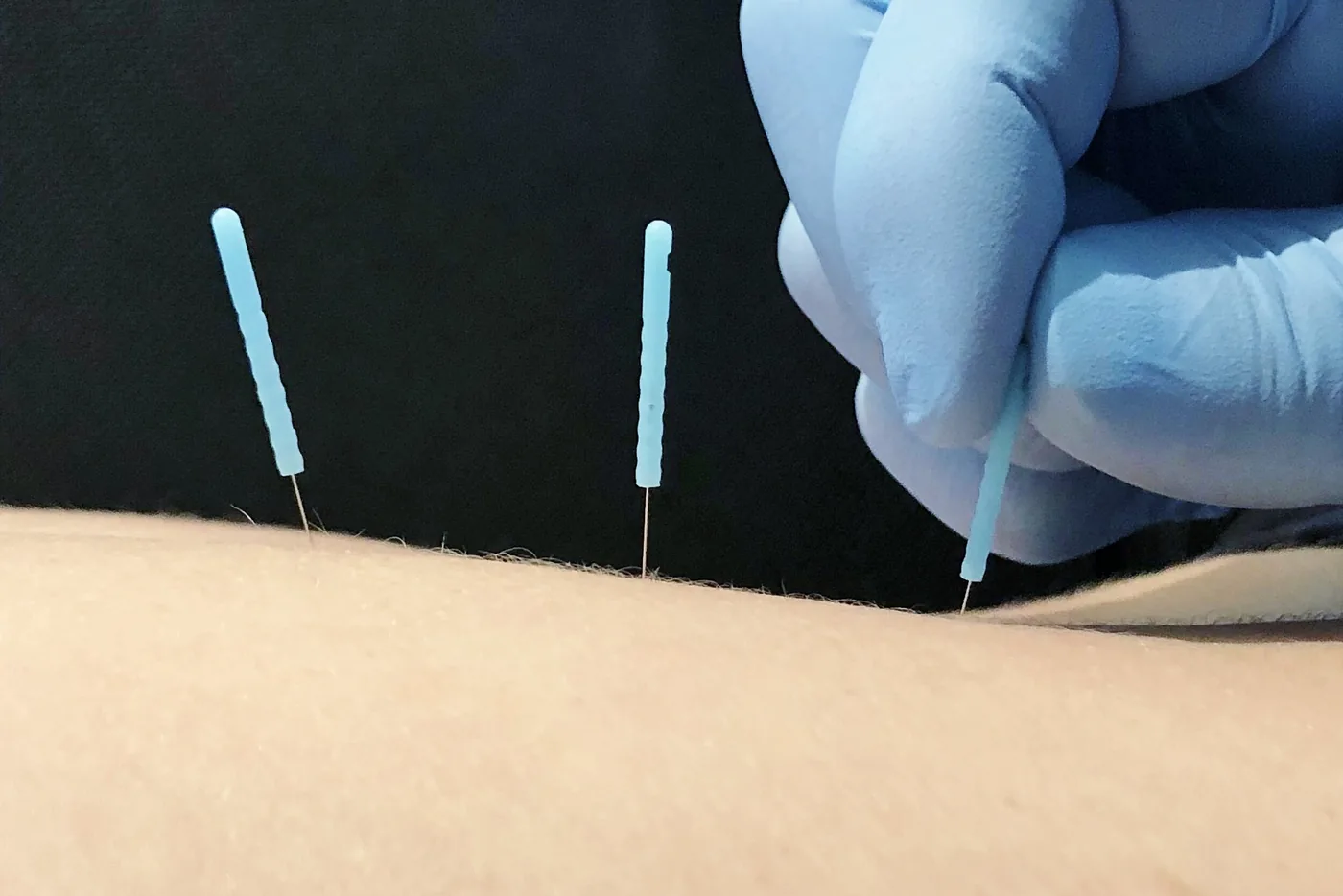
Dry needling uses a fine, sterile, single-use microfilament needle placed into a myofascial trigger point, a tendon or a ligament. Nothing is injected. A trigger point is a hard, irritable band inside a muscle that will not let go; in an athlete it is usually the product of repeated load, a previous strain, or a muscle compensating for a weaker one nearby.
Needling it “re-sets” the muscle: tension releases, blood flow increases, range of motion improves and the brain releases endorphins. For an athlete, the useful part is the range: a hip that rotates further, a calf that lets the ankle bend, a shoulder that reaches overhead without pinching. That range is a window, and what you do with it in the next hour decides whether it lasts.
It is not acupuncture. It is anatomy-led and chosen from an examination, which is explained in what dry needling treats.
The areas athletes most often need
- Hamstrings. Sprinters, field and court athletes and runners who keep straining the same hamstring often have a guarding band that never fully lets go between strains. Needling releases it; the strength work that follows is what stops the next strain. See recurring hamstring strains.
- Calves. Runners and court athletes load the calf on every step. A tight calf limits how far the ankle bends and pushes load into the Achilles, the shin and the plantar fascia. Needling the calf often reduces those symptoms quickly.
- Hips. The glutes, the deep hip rotators and the tissue along the outside of the thigh. A hip that will not rotate fully shows up as knee pain, IT band pain or a back that does the hip’s job.
- Shoulders and upper back. Throwing, swimming, lifting and racquet sports. Trigger points around the shoulder blade and rotator cuff limit overhead reach and change how the shoulder moves under load.
Which of these you need is decided by the examination. The area that hurts is often not the one driving the problem: we needle the tissue causing it, which is why a runner with knee pain may be needled at the hip.
Timing it across a training season
Needling leaves most people with mild soreness in the treated muscle for 24 to 48 hours, similar to the day after an unfamiliar workout. That one fact decides most of the timing.
- During a training build. The best time for a full session. Needle the muscle that keeps limiting you, then train the range you gained with loaded work in the same hour. Schedule it before an easy day, not before your hardest session of the week.
- After a heavy training block. A good time for a focused session, when several muscles have tightened and you have a lighter week ahead to absorb the soreness.
- Approaching competition. If you have been needled before and know how your body responds, a focused session a few days out can help. If you have never been needled, do not try it for the first time in race week; book it in a training block instead.
- During a flare-up. A muscle that has suddenly locked up mid-season is exactly what the 30-minute session is for, once the examination has ruled out a strain or a tear that needs something else.
Heavy loading of the exact muscle that was needled can wait a day. Light movement, an easy run or a technique session usually helps the soreness settle.
When the 30-minute session makes sense
In addition to using dry needling inside a larger plan, Osteopractic Physical Therapy offers a short, focused session purely for fast relief: before a race, after a heavy training week, or when a flare-up hits. It treats a specific area with Dr. Lockett and nothing else.
It suits athletes who already know which muscle tightens and how they respond to needling, and it fits a training schedule: thirty minutes between work and an evening session is a realistic amount of time to give up. It is described in full in the 30-minute dry needling session.
A full 60-minute visit is the better choice when the problem is new, when it keeps coming back, or when strength and movement need to be tested and trained as well. Thirty minutes releases a muscle. It does not find out why it keeps tightening.
How needling fits strength work
The strongest reason to use dry needling in a training season is what it lets you do straight afterwards. Range gained by the needle is used immediately under load: a hip hinge after hamstring needling, a single-leg calf raise after calf needling, overhead pressing after the shoulder. That loading is what tells the nervous system to keep the new range.
Where an injured area cannot yet take heavy weight, blood flow restriction training keeps strength work going with light loads; Dr. Lockett is certified in it. The combination of needling, manipulation where a joint is stiff, and progressive loading is the core of sports performance therapy here.
Without the strength work, needling becomes a recurring appointment for the same muscle. With it, the needle is needed less and less often.
Needling in return-to-sport rehab
After an injury, the muscles around the injured area often keep guarding long after the tissue has healed. That guarding limits range and changes how you move, which is one of the reasons re-injury is common when an athlete goes straight back to full load.
Needling those muscles is one part of return-to-sport rehab. The rest is testing: range, strength compared with your other side, single-leg control, landing and change of direction where your sport needs them. Being pain-free is not the same as being ready, as explained in return to sport after an injury.
What different sports tend to need
Every athlete is examined on their own terms, but the sport shapes where the load goes and therefore where trouble tends to collect.
- Runners. Calves, hamstrings and the hip muscles that control the knee. Tightness that builds with mileage, shin and Achilles symptoms, and knee pain that is really a hip problem. Needling is paired with calf and hip strength and a look at how mileage has changed.
- Lifters. The hips and low back after heavy pulling, the upper back and shoulders after pressing. Needling restores the range a lift needs, and the lift itself, at a lighter load, becomes the exercise that keeps it. See physical therapy for weightlifters.
- Court and field sports. Basketball, pickleball, tennis, soccer: hamstrings and calves from sprinting and cutting, hips from change of direction, shoulders and elbows from throwing and hitting.
- Golfers. The hips and mid-back, which decide how well you rotate, and the low back that takes over when they do not.
None of these is a protocol. They are the places the examination looks first.
What to tell us before your first session
A few details make the first visit far more useful. Your training week: what you do, on which days, and what the next race, game or meet is. The muscle or movement that bothers you, and at what point in a session it starts. Any previous strains or surgery on that side. Whether you have been needled before and how you responded. And any medication, especially blood thinners, or a bleeding disorder.
With that, the session can be timed around your calendar, the examination can start where the history points, and the loading after needling can use the movements your sport actually asks for. If you want to see the clinic first, the free discovery visit is a conversation, with no needle and no obligation.
Treatment at your gym
Sessions can take place at your gym in Dallas as well as at the clinic on North Central Expressway. For athletes that has a practical advantage: the movement that bothers you can be tested on the equipment you actually train with, and the loading after needling uses your own setup.
Every full visit is 60 minutes, one-on-one with Dr. Lockett, never handed to an aide. See mobile physical therapy.
Cost and booking
- Free discovery visit: No charge — finding out whether this approach fits your problem
- 30-minute dry needling: See sessions & packages — a known muscle, before a race or after a heavy week
- 6-visit pain/movement plan: $840 — an injury or a recurring problem that needs a plan
- 12-visit performance package: $1,560 — ongoing performance, mobility and preventative care across a season
The practice is out-of-network; a superbill is provided at the end of every session for your own insurance claim. No referral is needed: Texas allows direct access to physical therapy.
Who should not have dry needling
Tell us first if you take blood-thinning medication or have a bleeding disorder, are pregnant, have an active infection or open wound over the area, or would rather not fight a needle phobia; there are other tools. A muscle that tore with a pop, bruised heavily or cannot take your weight needs to be examined, and sometimes imaged, before anyone needles it.
Needling around the shoulder blade and rib cage requires particular anatomical care because the lung sits close underneath. New chest pain or shortness of breath after any needling needs urgent medical care.
Questions people ask
Dry needling for athletes in Dallas
Osteopractic Physical Therapy & Pain Relief in North Dallas provides dry needling for athletes with Dr. Brent Lockett, PT, DPT, Cert. DN: in a 60-minute one-on-one visit with strength work, or as a 30-minute focused session before a race or after a heavy training week, at the clinic or your gym. No referral is needed.
How close to a race can I get dry needling?
If you have been needled before and know your response, a focused session a few days out can help. Never try it for the first time in race week, because of the 24 to 48 hours of soreness that often follows.
Can I train after dry needling?
Light movement, an easy run or a technique session usually helps. Heavy loading of the exact muscle that was needled can wait a day.
What does dry needling help athletes with?
Tight, guarding muscles that limit range: most often the hamstrings, calves, hip muscles and the muscles around the shoulder, and the overuse problems they feed into.
Does the 30-minute session replace a full visit?
No. It releases a known muscle quickly. A new or recurring problem needs the full hour so strength and movement can be tested and trained.
Can dry needling be done at my gym?
Yes. Sessions can take place at your gym in Dallas, so the movement can be tested and loaded on the equipment you train with.
Do I need a referral for dry needling in Texas?
No. Texas allows direct access to physical therapy. An acute injury that needs imaging should be seen by a physician first.